Classes2 added16 changed
Diagrams15 changed
Click a count to show only those itemspAdded — only in destinationDeleted — only in baselineMoved — same GUID, different packageChanged — same GUID and package; properties or members differIdenticalPackage (unchanged itself)struckinserted — destination text with baseline wording struck (notes, role notes, role names, multiplicities); the shows the notes and every changed propertyBlue — a changed attribute type (the new type)
▶Gridi
{21D32832-FF64-4213-B81C-55ACE35EEBFF}
Package notes
This top package includes the CIM model related to the grid.Package metadata — changes
| Baseline | Destination | |
|---|---|---|
| no changes | ||
Tagged values — changes
| Baseline | Destination | |
|---|---|---|
| no changes | ||
Package notes
This top package includes the CIM model related to the grid.▶Basei
{20A2C6D8-4765-466f-AD75-5E1B3CAF4E8D}
Package notes
Content of the base CIM. The information in the entire clause "Common Information Model Base Package" is reproduced from the UML with the permission of UCAIug.Package metadata — changes
| Baseline | Destination | |
|---|---|---|
| no changes | ||
Tagged values — changes
| Baseline | Destination | |
|---|---|---|
| no changes | ||
Package notes
Content of the base CIM. The information in the entire clause "Common Information Model Base Package" is reproduced from the UML with the permission of UCAIug.▶Corei
{6A503B72-6E15-4cd1-B92D-DDF6D14DBE29}
Package notes
Contains the core PowerSystemResource and ConductingEquipment entities shared by all applications plus common collections of those entities. Not all applications require all the Core entities. This package does not depend on any other package except the Domain package, but most of the other packages have associations and generalizations that depend on it.Package metadata — changes
| Baseline | Destination | |
|---|---|---|
| no changes | ||
Tagged values — changes
| Baseline | Destination | |
|---|---|---|
| no changes | ||
Package notes
Contains the core PowerSystemResource and ConductingEquipment entities shared by all applications plus common collections of those entities. Not all applications require all the Core entities. This package does not depend on any other package except the Domain package, but most of the other packages have associations and generalizations that depend on it.Changed classes (1)
▶⚙ACDCTerminali
CHANGED{D37077B9-3B0C-4c16-8F5F-9A6F2C83A7F2}
Class notes
An electrical connection point (AC or DC) to a piece of conducting equipment. Terminals are connected at physical connection points called connectivity nodes.Class metadata — changes
| Baseline | Destination | |
|---|---|---|
| no changes | ||
Tagged values — changes
| Baseline | Destination | |
|---|---|---|
| no changes | ||
Class notes
An electrical connection point (AC or DC) to a piece of conducting equipment. Terminals are connected at physical connection points called connectivity nodes.≡Attributes
| Attribute | Baseline | Destination | Notes (destination, redlined) | |||||||||||||||
|---|---|---|---|---|---|---|---|---|---|---|---|---|---|---|---|---|---|---|
| «deprecated» connectedimetadata changed - hovermetadata changedrenamed from connected{C97C0B38-C62F-4f03-A3DE-A67F29A6C6DB}show details | Boolean [0..1] | Boolean [0..1] | The connected status is related to a bus-branch model and the topological node to terminal relation. True implies the terminal is connected to the related topological node and false implies it is not. In a bus-branch model, the connected status is used to tell if equipment is disconnected without having to change the connectivity described by the topological node to terminal relation. A valid case is that conducting equipment can be connected in one end and open in the other. In particular for an AC line segment, where the reactive line charging can be significant, this is a relevant case. | |||||||||||||||
Attribute notes The connected status is related to a bus-branch model and the topological node to terminal relation. True implies the terminal is connected to the related topological node and false implies it is not.
In a bus-branch model, the connected status is used to tell if equipment is disconnected without having to change the connectivity described by the topological node to terminal relation. A valid case is that conducting equipment can be connected in one end and open in the other. In particular for an AC line segment, where the reactive line charging can be significant, this is a relevant case.Attribute metadata — changes
Tagged values — changes
| ||||||||||||||||||
Package 'Core' has no changes to the 7 diagrams it contains.
▶Wiresi
{6C99E9CA-2035-4035-B77F-9217E17D86F4}
Package notes
An extension to the Core and Topology package that models information on the electrical characteristics of Transmission and Distribution networks. This package is used by network applications such as State Estimation, Load Flow and Optimal Power Flow.Package metadata — changes
| Baseline | Destination | |
|---|---|---|
| no changes | ||
Tagged values — changes
| Baseline | Destination | |
|---|---|---|
| no changes | ||
Package notes
An extension to the Core and Topology package that models information on the electrical characteristics of Transmission and Distribution networks. This package is used by network applications such as State Estimation, Load Flow and Optimal Power Flow.Added classes (1)
▶⚙VariableShuntCompensatori
ADDED{79BA3145-B3D2-4dd1-B6E0-E0A599D09C83}
Class notes
A variable shunt compensator (VSR) is an oil-filled reactor with discrete on-line regulation of reactive power. The regulation range typically varies between 30% and 100% of the rated reactive power. When energized VSR cannot have a reactive output of 0 Mvar, so minimal valid section number is 1 with reactive power output at either 100% or at minimal reactive power output. Note that reactive power can increase or decrease with increasing of the section number (NonlinearShuntCompensatorPoint.sectionNumber).Class metadata — changes
| Baseline | Destination | |
|---|---|---|
| Abstract | false | |
| Author | chiva | |
| Complexity | 1 | |
| GenType | Java | |
| IsLeaf | false | |
| IsRoot | false | |
| IsSpec | false | |
| Name | VariableShuntCompensator | |
| ParentPackage | Wires | |
| Phase | 1.0 | |
| Scope | public | |
| Status | Proposed | |
| Type | Class | |
| Version | 1.0 |
Tagged values — changes
| Baseline | Destination | |
|---|---|---|
| none | ||
Class notes
A variable shunt compensator (VSR) is an oil-filled reactor with discrete on-line regulation of reactive power. The regulation range typically varies between 30% and 100% of the rated reactive power. When energized VSR cannot have a reactive output of 0 Mvar, so minimal valid section number is 1 with reactive power output at either 100% or at minimal reactive power output. Note that reactive power can increase or decrease with increasing of the section number (NonlinearShuntCompensatorPoint.sectionNumber).▤Metadata
| Baseline | Destination | |
|---|---|---|
| Abstract | false | |
| Author | chiva | |
| Complexity | 1 | |
| GenType | Java | |
| IsLeaf | false | |
| IsRoot | false | |
| IsSpec | false | |
| Name | VariableShuntCompensator | |
| ParentPackage | Wires | |
| Phase | 1.0 | |
| Scope | public | |
| Status | Proposed | |
| Type | Class | |
| Version | 1.0 |
⇄Links
ADDEDGeneralization{D834B8AE-9499-41fb-8AFE-44BEEF89002E}
Link metadata
| Baseline | Destination | |
|---|---|---|
| Direction | Source -> Destination | |
| Type | Generalization |
Source end
| Baseline | Destination | |
|---|---|---|
| Cardinality | 0 | |
| Containment | Unspecified | |
| End | Variable | |
| IsAggregation | 0 | |
| IsChangeable | none | |
| IsNavigable | false | |
| Ordering | false | |
| Scope | Public | |
| TargetScope | instance |
Target end
| Baseline | Destination | |
|---|---|---|
| Cardinality | 0 | |
| Containment | Unspecified | |
| End | Nonlinear | |
| IsAggregation | 0 | |
| IsChangeable | none | |
| IsNavigable | true | |
| Ordering | false | |
| Scope | Public | |
| TargetScope | instance |
Changed classes (2)
▶⚙NonlinearShuntCompensatori
CHANGED{111DB4FF-7967-4eb5-AABE-CDA0EA065CF8}
Class notes
A non linear shunt compensator has bank or section admittance values that differ. The attributes gTotal, bTotal, g0Total and b0Total of the associated NonlinearShuntCompensatorPoint describe the total conductance and admittance of a NonlinearShuntCompensatorPoint at a section number specified by NonlinearShuntCompensatorPoint.sectionNumber.Class metadata — changes
| Baseline | Destination | |
|---|---|---|
| no changes | ||
Tagged values — changes
| Baseline | Destination | |
|---|---|---|
| no changes | ||
Class notes
A non linear shunt compensator has bank or section admittance values that differ. The attributes gTotal, bTotal, g0Total and b0Total of the associated NonlinearShuntCompensatorPoint describe the total conductance and admittance of a NonlinearShuntCompensatorPoint at a section number specified by NonlinearShuntCompensatorPoint.sectionNumber.⇄Links
ADDEDGeneralization{D834B8AE-9499-41fb-8AFE-44BEEF89002E}
Link metadata
| Baseline | Destination | |
|---|---|---|
| Direction | Source -> Destination | |
| Type | Generalization |
Source end
| Baseline | Destination | |
|---|---|---|
| Cardinality | 0 | |
| Containment | Unspecified | |
| End | Variable | |
| IsAggregation | 0 | |
| IsChangeable | none | |
| IsNavigable | false | |
| Ordering | false | |
| Scope | Public | |
| TargetScope | instance |
Target end
| Baseline | Destination | |
|---|---|---|
| Cardinality | 0 | |
| Containment | Unspecified | |
| End | Nonlinear | |
| IsAggregation | 0 | |
| IsChangeable | none | |
| IsNavigable | true | |
| Ordering | false | |
| Scope | Public | |
| TargetScope | instance |
▶⚙RatioTapChangeri
CHANGED{09909286-00A6-451c-B420-2E52ABEB2667}
Class notes
A tap changer that changes the voltage ratio impacting the voltage magnitude but not the phase angle across the transformer.
Angle sign convention (general): Positive value indicates a positive phase shift from the winding where the tap is located to the other winding (for a two-winding transformer).Class metadata — changes
| Baseline | Destination | |
|---|---|---|
| no changes | ||
Tagged values — changes
| Baseline | Destination | |
|---|---|---|
| no changes | ||
Class notes
A tap changer that changes the voltage ratio impacting the voltage magnitude but not the phase angle across the transformer.
Angle sign convention (general): Positive value indicates a positive phase shift from the winding where the tap is located to the other winding (for a two-winding transformer).≡Attributes
| Attribute | Baseline | Destination | Notes (destination, redlined) | |||||||||||||||||||||||||||||||||||||||||||||||||||
|---|---|---|---|---|---|---|---|---|---|---|---|---|---|---|---|---|---|---|---|---|---|---|---|---|---|---|---|---|---|---|---|---|---|---|---|---|---|---|---|---|---|---|---|---|---|---|---|---|---|---|---|---|---|---|
| tculControlModei{A7105B45-FAF9-4012-9A98-CCFA67F55C96}show details | TransformerControlMode [0..1] | removed from model | ||||||||||||||||||||||||||||||||||||||||||||||||||||
Attribute notes (baseline) Specifies the regulation control mode (voltage or reactive) of the RatioTapChanger.Attribute metadata — changes
Tagged values — changes
| ||||||||||||||||||||||||||||||||||||||||||||||||||||||
Changed diagrams (2)
▶▦Datatypesi
CHANGED{7F25DAE7-CB22-4224-AFEB-7F0BD8317D69}
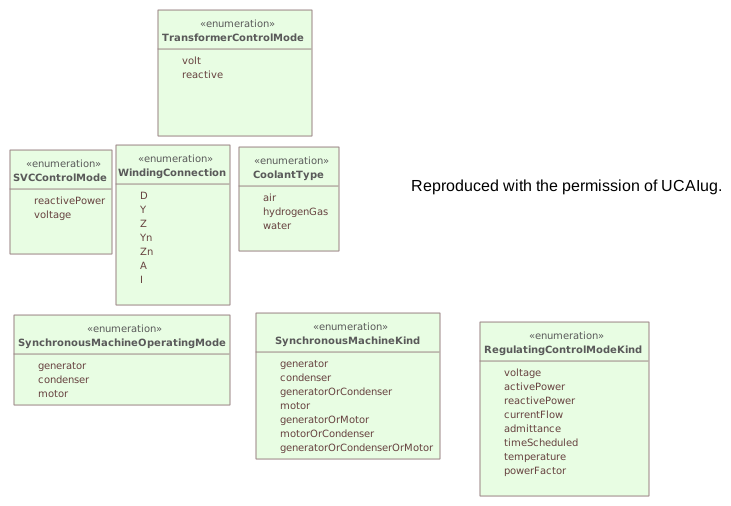
Diagram notes
This diagram shows the data types specific to the Wires package.Diagram metadata — changes
| Baseline | Destination | |
|---|---|---|
| no changes | ||
Diagram notes
This diagram shows the data types specific to the Wires package.▦Diagram
removed
Baseline
Destination
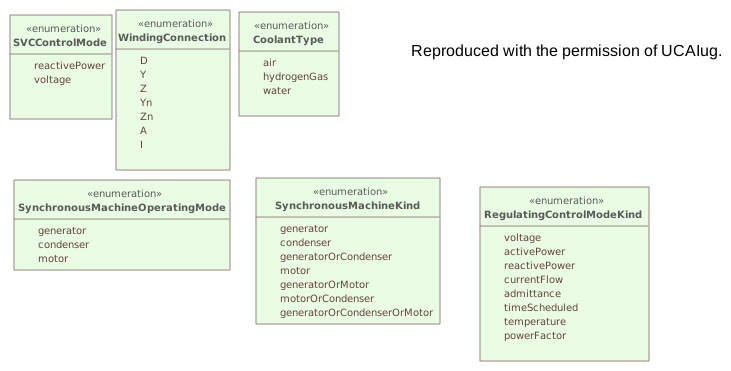
▶▦ShuntCompensatori
CHANGED{3CAA0009-F451-4e6d-BEDE-2AD7E67D3C35}
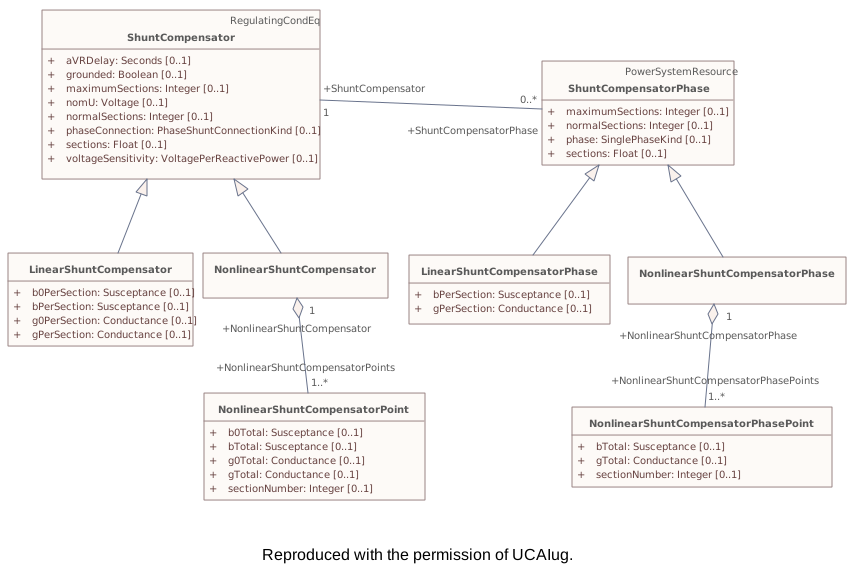
Diagram notes
Shows shunt compensator inheritance structure.Diagram metadata — changes
| Baseline | Destination | |
|---|---|---|
| ModifiedDate | 2023-02-11 11:24:26 | 2023-02-19 08:04:55 |
Diagram notes
Shows shunt compensator inheritance structure.▤Metadata
| Baseline | Destination | |
|---|---|---|
| ModifiedDate | 2023-02-11 11:24:26 | 2023-02-19 08:04:55 |
▦Diagram
addedchangedmoved or resized
Baseline
Destination
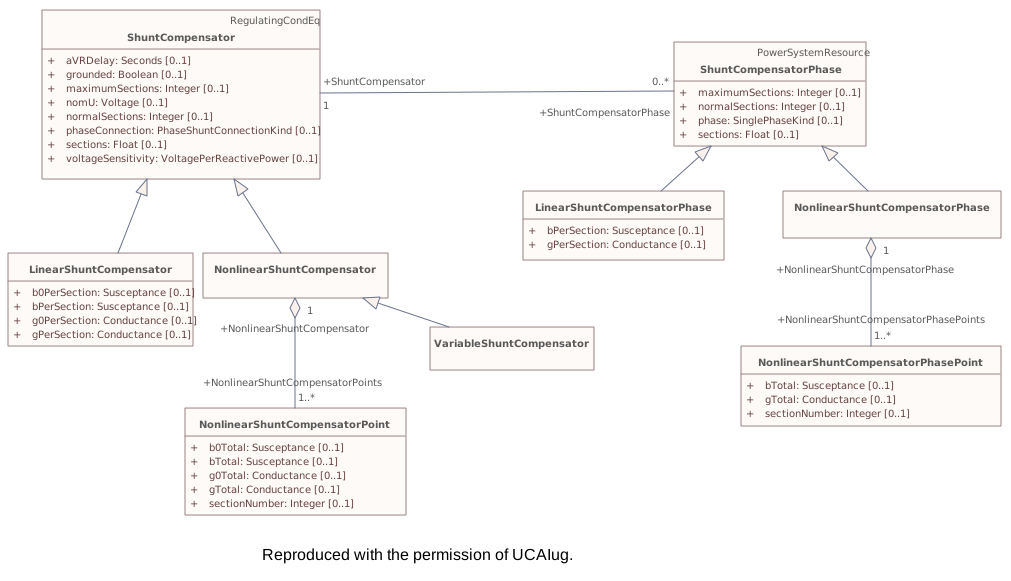
Connectors 1 addedhover a connector to outline the elements it joins
addedVariableShuntCompensator – NonlinearShuntCompensator
▶LoadModeli
{427D9D64-CDA2-4070-AAC6-04A32F290872}
Package notes
This package is responsible for modelling the energy consumers and the system load as curves and associated curve data. Special circumstances that may affect the load, such as seasons and day types, are also included here.
This information is used by Load Forecasting and Load Management.Package metadata — changes
| Baseline | Destination | |
|---|---|---|
| no changes | ||
Tagged values — changes
| Baseline | Destination | |
|---|---|---|
| no changes | ||
Package notes
This package is responsible for modelling the energy consumers and the system load as curves and associated curve data. Special circumstances that may affect the load, such as seasons and day types, are also included here.
This information is used by Load Forecasting and Load Management.Changed classes (1)
▶⚙LoadResponseCharacteristici
CHANGED{F80EE4DD-B985-47e3-9832-B5005C24C87E}
Class notes (destination, redlined)
Models the characteristic response of the load demand due to changes in system conditions such as voltage and frequency. It is not related to demand response.
If LoadResponseCharacteristic.exponentModel is True, the exponential voltage or frequency dependent models are specified and used as to calculate active and reactive power components of the load model.
The equations to calculate active and reactive power components of the load model are internal to the power flow calculation, hence they use different quantities depending on the use case of the data exchange.
The equations for exponential voltage dependent load model injected power are:
pInjection= Pnominal* (Voltage/cim:BaseVoltage.nominalVoltage) ** cim:LoadResponseCharacteristic.pVoltageExponent
qInjection= Qnominal* (Voltage/cim:BaseVoltage.nominalVoltage) ** cim:LoadResponseCharacteristic.qVoltageExponent
pInjection = Pnominal* (Frequency/(Nominal frequency))**cim:LoadResponseCharacteristic.pFrequencyExponent
qInjection = Qnominal* (Frequency/(Nominal frequency))**cim:LoadResponseCharacteristic.qFrequencyExponent
Note that both voltage and frequency exponents could be used together so the full equation would be:
pInjection = Pnominal* (Voltage/(cim:BaseVoltage.nominalVoltage))**cim:LoadResponseCharacteristic.pVoltageExponent * (Frequency/(base frequency))**cim:LoadResponseCharacteristic.pFrequencyExponent
qInjection = Qnominal* (Voltage/(cim:BaseVoltage.nominalVoltage))**cim:LoadResponseCharacteristic.qVoltageExponent * (Frequency/(base frequency))**cim:LoadResponseCharacteristic.qFrequencyExponent
The voltage and frequency expressed in the equation are values obtained from solved power flow. Base voltage and base frequency are those derived from the connectivity of the static network model.
Where:
1) * means "multiply" and ** is "raised to the power of";
2) Pnominal and Qnominal represent the active power and reactive power at nominal voltage as any load described by the voltage exponential model shall be given at nominal voltage. This means that EnergyConsumer.p and EnergyConsumer.q are at nominal voltage.
3) After power flow is solved:
-pInjection and qInjection correspond to SvPowerflow.p and SvPowerflow.q respectively.
- Voltage corresponds to SvVoltage.v at the TopologicalNode where the load is connected.Class metadata — changes
| Baseline | Destination | |
|---|---|---|
| no changes | ||
Tagged values — changes
| Baseline | Destination | |
|---|---|---|
| no changes | ||
Class notes (destination, redlined)
Models the characteristic response of the load demand due to changes in system conditions such as voltage and frequency. It is not related to demand response.
If LoadResponseCharacteristic.exponentModel is True, the exponential voltage or frequency dependent models are specified and used as to calculate active and reactive power components of the load model.
The equations to calculate active and reactive power components of the load model are internal to the power flow calculation, hence they use different quantities depending on the use case of the data exchange.
The equations for exponential voltage dependent load model injected power are:
pInjection= Pnominal* (Voltage/cim:BaseVoltage.nominalVoltage) ** cim:LoadResponseCharacteristic.pVoltageExponent
qInjection= Qnominal* (Voltage/cim:BaseVoltage.nominalVoltage) ** cim:LoadResponseCharacteristic.qVoltageExponent
pInjection = Pnominal* (Frequency/(Nominal frequency))**cim:LoadResponseCharacteristic.pFrequencyExponent
qInjection = Qnominal* (Frequency/(Nominal frequency))**cim:LoadResponseCharacteristic.qFrequencyExponent
Note that both voltage and frequency exponents could be used together so the full equation would be:
pInjection = Pnominal* (Voltage/(cim:BaseVoltage.nominalVoltage))**cim:LoadResponseCharacteristic.pVoltageExponent * (Frequency/(base frequency))**cim:LoadResponseCharacteristic.pFrequencyExponent
qInjection = Qnominal* (Voltage/(cim:BaseVoltage.nominalVoltage))**cim:LoadResponseCharacteristic.qVoltageExponent * (Frequency/(base frequency))**cim:LoadResponseCharacteristic.qFrequencyExponent
The voltage and frequency expressed in the equation are values obtained from solved power flow. Base voltage and base frequency are those derived from the connectivity of the static network model.
Where:
1) * means "multiply" and ** is "raised to the power of";
2) Pnominal and Qnominal represent the active power and reactive power at nominal voltage as any load described by the voltage exponential model shall be given at nominal voltage. This means that EnergyConsumer.p and EnergyConsumer.q are at nominal voltage.
3) After power flow is solved:
-pInjection and qInjection correspond to SvPowerflow.p and SvPowerflow.q respectively.
- Voltage corresponds to SvVoltage.v at the TopologicalNode where the load is connected.Class 'LoadResponseCharacteristic' has no other changes. The shows its notes and every changed property.
Package 'LoadModel' has no changes to the 1 diagrams it contains.
▶DCi
{6CA575E7-020B-40d8-B841-027BF8B51BE9}
Package notes
This package contains model for direct current equipment and controls.Package metadata — changes
| Baseline | Destination | |
|---|---|---|
| no changes | ||
Tagged values — changes
| Baseline | Destination | |
|---|---|---|
| no changes | ||
Package notes
This package contains model for direct current equipment and controls.Package 'DC' has no changes to the 30 classes it contains.
Changed diagrams (2)
▶▦ACDCConnectivityModeli
CHANGED{43531300-1039-4de2-880E-A73AFC65A581}
Diagram notes
This diagram shows connectivity and topology model for both AC and DC networks.Diagram metadata — changes
| Baseline | Destination | |
|---|---|---|
| no changes | ||
Diagram notes
This diagram shows connectivity and topology model for both AC and DC networks.▦Diagram
changed
Baseline
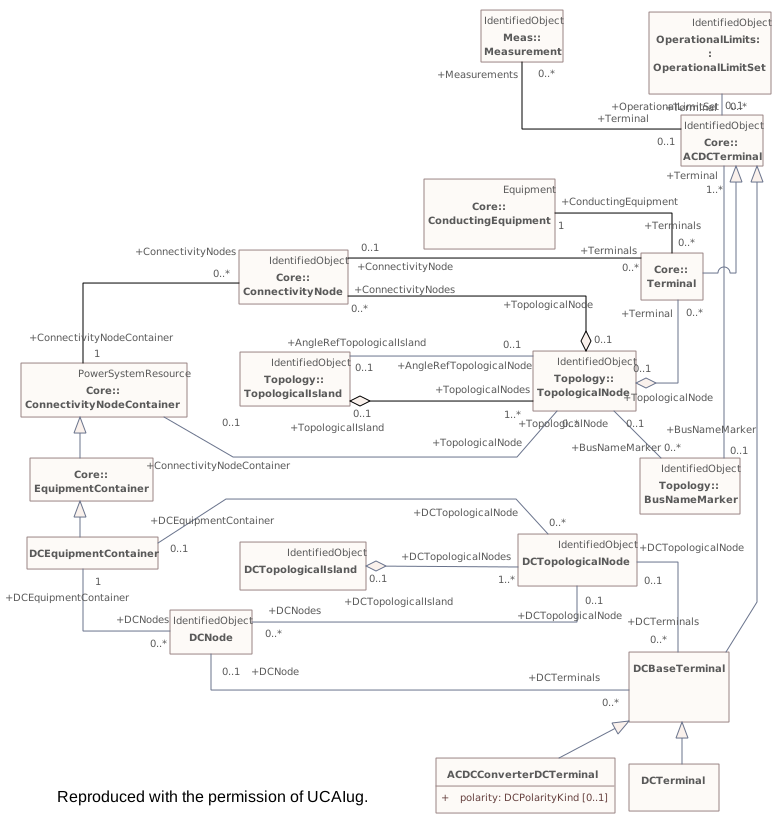
Destination
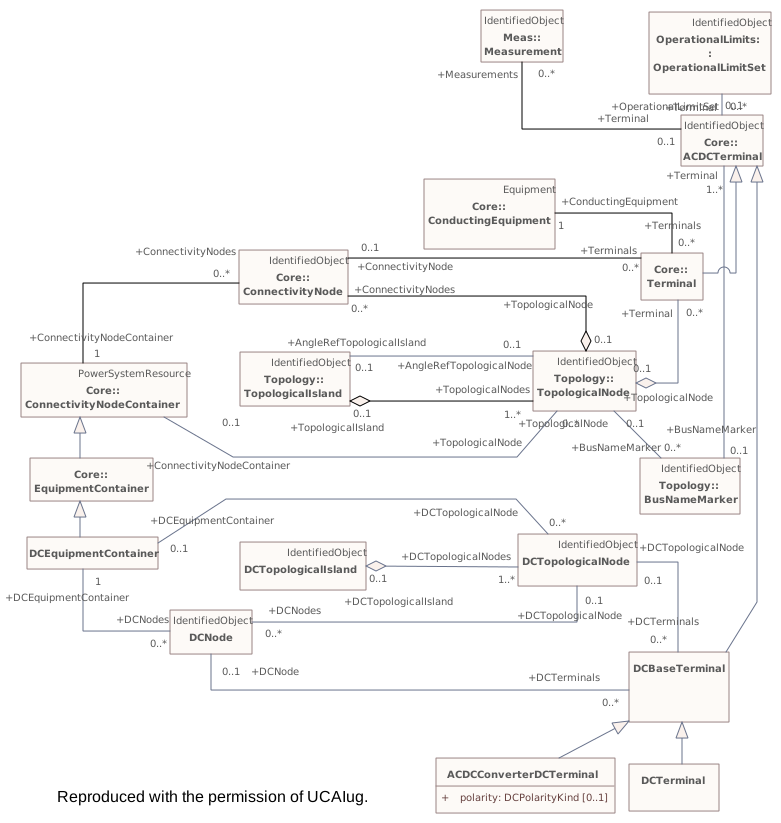
▶▦DCEquipmenti
CHANGED{A060A742-BA22-4a1c-A24F-5862D1F35B87}
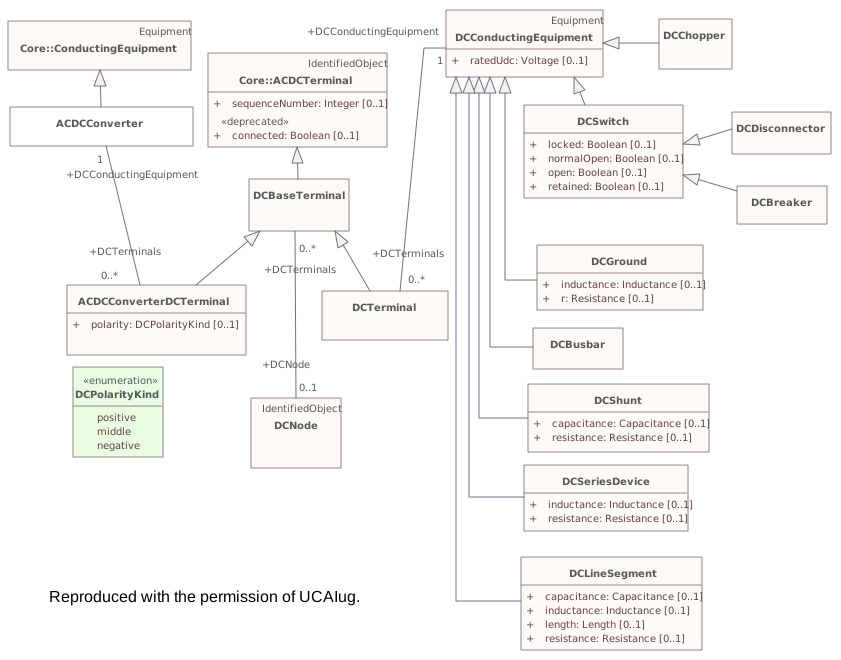
Diagram notes
The diagram show the DC equipment model.Diagram metadata — changes
| Baseline | Destination | |
|---|---|---|
| no changes | ||
Diagram notes
The diagram show the DC equipment model.▦Diagram
changed
Baseline
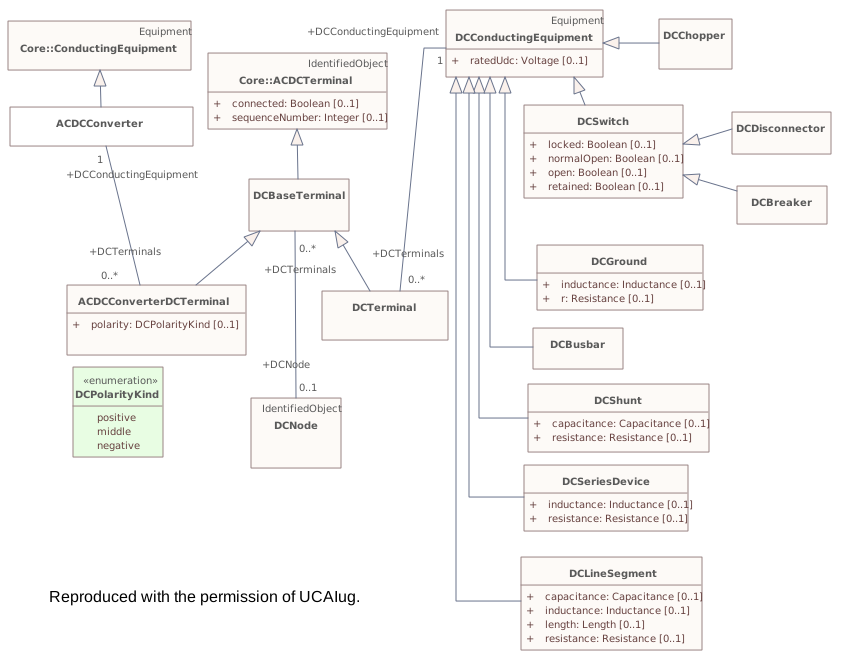
Destination
▶Measi
{6B58A5C3-5CC1-4320-A9D3-2CABB8F9399E}
Package notes
Contains entities that describe dynamic measurement data exchanged between applications.Package metadata — changes
| Baseline | Destination | |
|---|---|---|
| no changes | ||
Tagged values — changes
| Baseline | Destination | |
|---|---|---|
| no changes | ||
Package notes
Contains entities that describe dynamic measurement data exchanged between applications.Package 'Meas' has no changes to the 29 classes it contains.
Changed diagrams (1)
▶▦Measurementi
CHANGED{8013CE5A-1E8B-43a7-8A3D-29DA0B40602A}
Diagram notes
This diagram shows classes central to the Measurement package and connections to some external classes.Diagram metadata — changes
| Baseline | Destination | |
|---|---|---|
| no changes | ||
Diagram notes
This diagram shows classes central to the Measurement package and connections to some external classes.▦Diagram
changed
Baseline
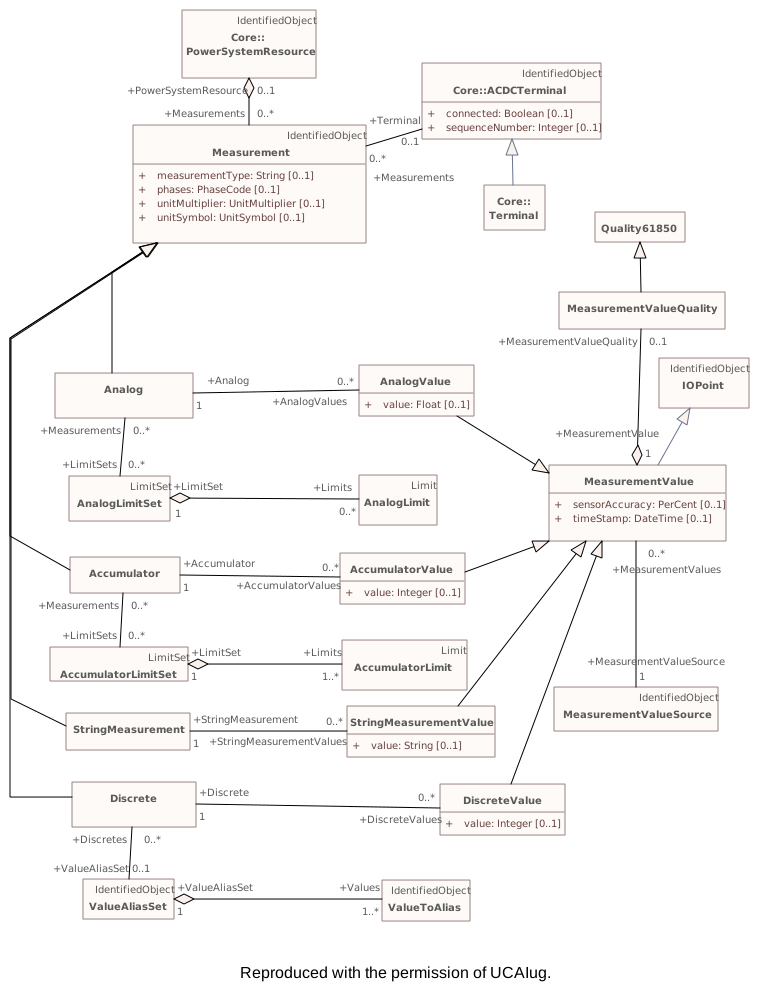
Destination
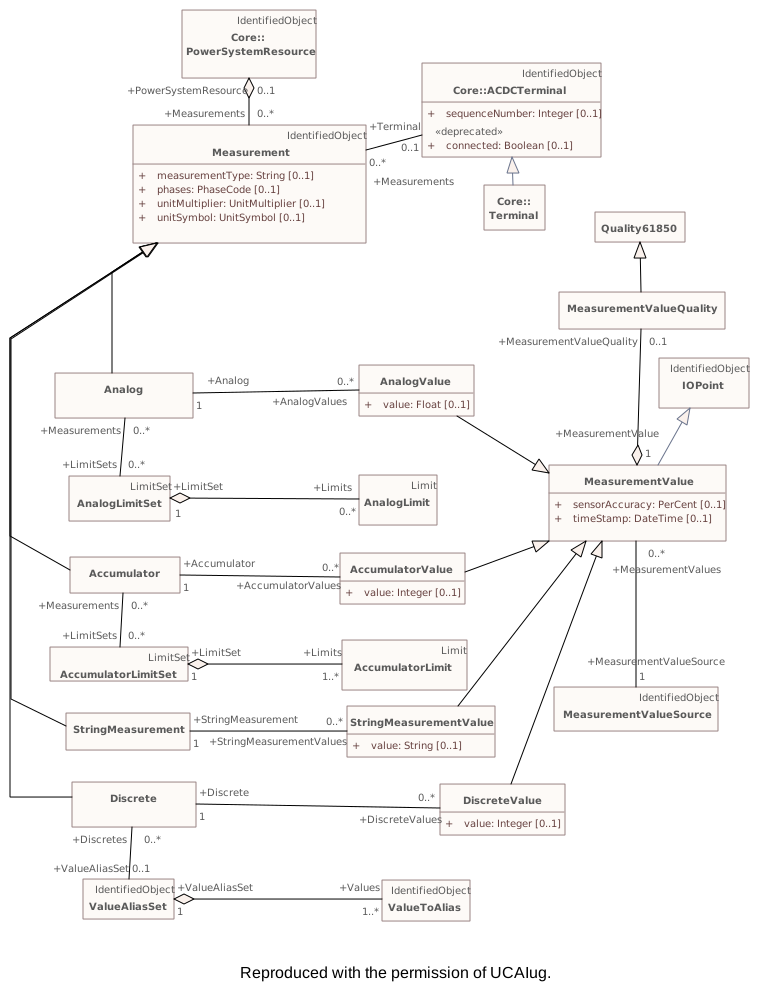
▶Topologyi
{E44AA599-D1DD-4d0c-8487-AE8BE9E6FEEB}
Package notes
An extension to the Core Package that, in association with the Terminal class, models Connectivity, that is the physical definition of how equipment is connected together. In addition it models Topology, that is the logical definition of how equipment is connected via closed switches. The Topology definition is independent of the other electrical characteristics.Package metadata — changes
| Baseline | Destination | |
|---|---|---|
| no changes | ||
Tagged values — changes
| Baseline | Destination | |
|---|---|---|
| no changes | ||
Package notes
An extension to the Core Package that, in association with the Terminal class, models Connectivity, that is the physical definition of how equipment is connected together. In addition it models Topology, that is the logical definition of how equipment is connected via closed switches. The Topology definition is independent of the other electrical characteristics.Package 'Topology' has no changes to the 3 classes it contains.
Changed diagrams (1)
▶▦Maini
CHANGED{BED90F47-24EF-4af0-A8CD-1DB3BE1E6A2E}
Diagram notes
This diagram shows all classes included in the Topology package as well as the key external classes that have associations with Topology classes.Diagram metadata — changes
| Baseline | Destination | |
|---|---|---|
| no changes | ||
Diagram notes
This diagram shows all classes included in the Topology package as well as the key external classes that have associations with Topology classes.▦Diagram
changed
Baseline
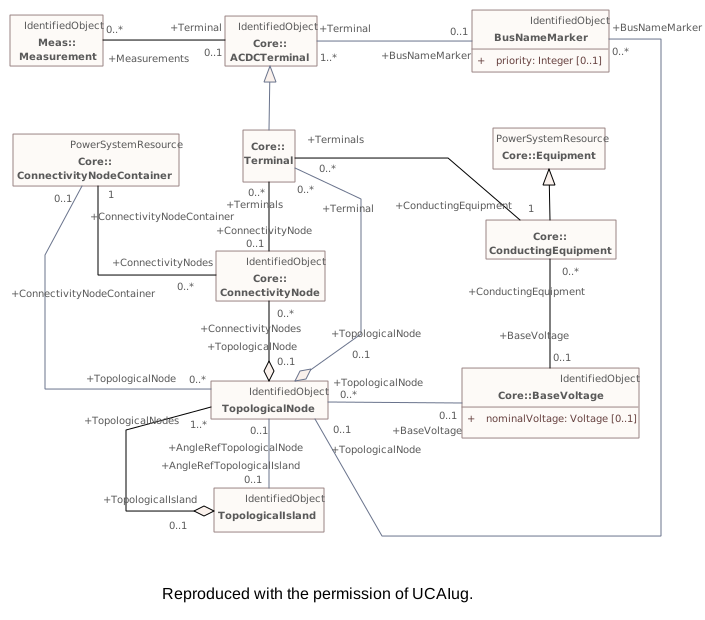
Destination
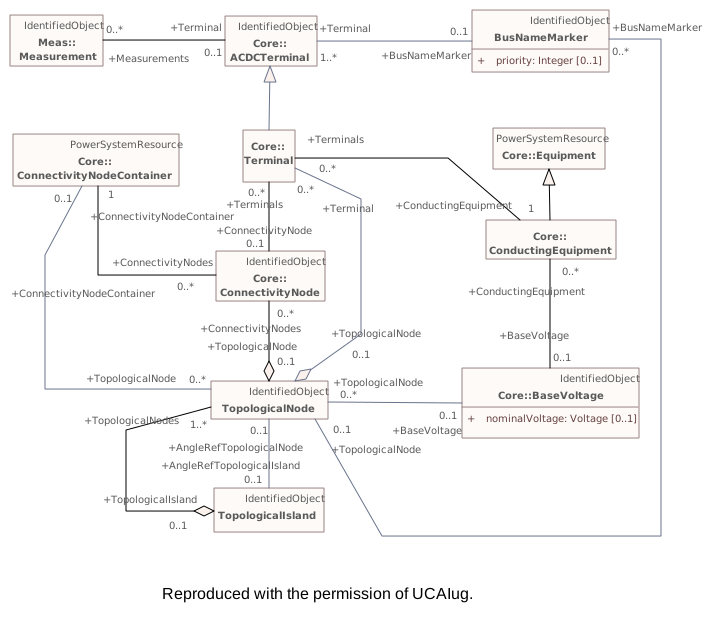
▶OperationalLimitsi
{CCAAF4EA-4C50-4438-86F9-63852950B3CA}
Package notes
This package models a specification of limits associated with equipment and other operational entities.Package metadata — changes
| Baseline | Destination | |
|---|---|---|
| no changes | ||
Tagged values — changes
| Baseline | Destination | |
|---|---|---|
| no changes | ||
Package notes
This package models a specification of limits associated with equipment and other operational entities.Package 'OperationalLimits' has no changes to the 10 classes it contains.
Changed diagrams (2)
▶▦BranchGroupi
CHANGED{DE2F00E8-B731-43ce-B01C-7267ED3D9F4E}
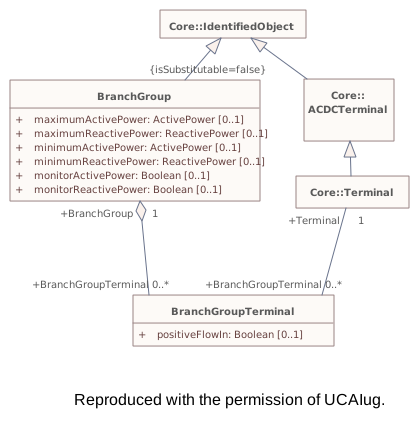
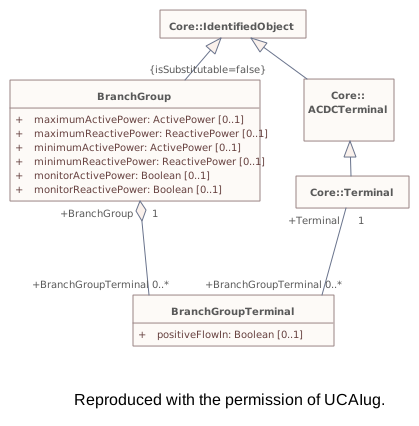
Diagram notes
This diagram shows the model for monitoring combined flows on groups of branches.Diagram metadata — changes
| Baseline | Destination | |
|---|---|---|
| no changes | ||
Diagram notes
This diagram shows the model for monitoring combined flows on groups of branches.▦Diagram
changed
Baseline
Destination
▶▦OperationalLimitsi
CHANGED{6B0E5843-FA70-4495-BB16-CD2B0CAA01B5}
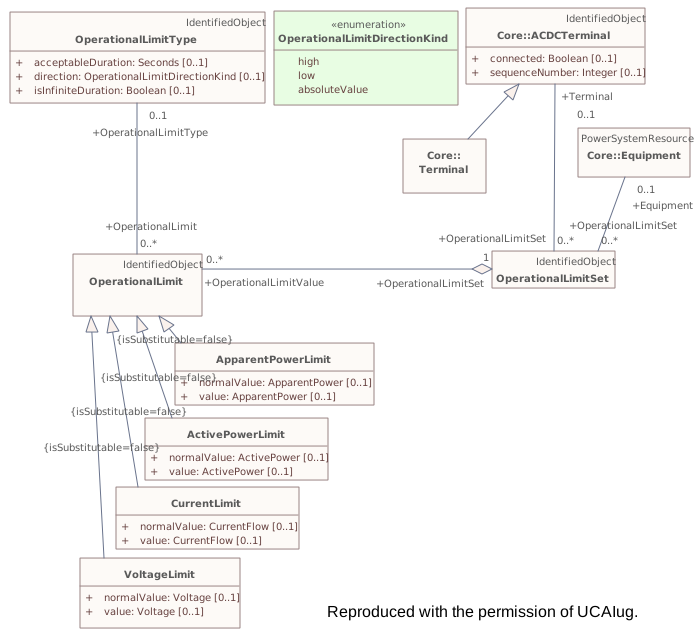
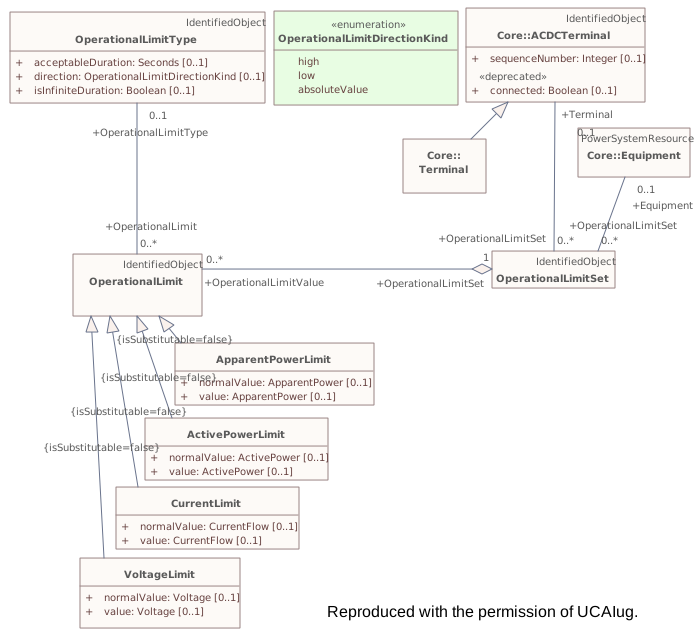
Diagram notes
This diagram shows operational limits as they tie back into the core model.Diagram metadata — changes
| Baseline | Destination | |
|---|---|---|
| no changes | ||
Diagram notes
This diagram shows operational limits as they tie back into the core model.▦Diagram
changed
Baseline
Destination
▶Dynamicsi
{A71B9185-6D48-40f4-B618-485C08C4F269}
Package notes
The CIM dynamic model definitions reflect the most common IEEE or, in the case of wind models, IEC, representations of models as well as models included in some of the transient stability software widely used by utilities.
These dynamic models are intended to ensure interoperability between different vendors’ software products currently in use by electric utility energy companies, utilities, Transmission System Operators (TSOs), Regional Transmission Organizations (RTOs), and Independent System Operators (ISOs). It is important to note that each vendor is free to select its own internal implementation of these models. Differences in vendor results, as long as they are within accepted engineering practice, caused by different internal representations, are acceptable.
Unless explicitly stated otherwise, the following modelling conventions are followed:
- limited integrators are of the non-windup type;
- it shall be possible to enter a time constant of zero (where it makes sense).
The information in the entire clause "Common Information Model Dynamics package" is reproduced from the UML with the permission of UCAIug.Package metadata — changes
| Baseline | Destination | |
|---|---|---|
| no changes | ||
Tagged values — changes
| Baseline | Destination | |
|---|---|---|
| no changes | ||
Package notes
The CIM dynamic model definitions reflect the most common IEEE or, in the case of wind models, IEC, representations of models as well as models included in some of the transient stability software widely used by utilities.
These dynamic models are intended to ensure interoperability between different vendors’ software products currently in use by electric utility energy companies, utilities, Transmission System Operators (TSOs), Regional Transmission Organizations (RTOs), and Independent System Operators (ISOs). It is important to note that each vendor is free to select its own internal implementation of these models. Differences in vendor results, as long as they are within accepted engineering practice, caused by different internal representations, are acceptable.
Unless explicitly stated otherwise, the following modelling conventions are followed:
- limited integrators are of the non-windup type;
- it shall be possible to enter a time constant of zero (where it makes sense).
The information in the entire clause "Common Information Model Dynamics package" is reproduced from the UML with the permission of UCAIug.▶StandardModelsi
{1BEB429C-BFD0-49c6-9556-AC7BA58C2202}
Package notes
This subclause contains standard dynamic model specifications grouped into packages by standard function block (type of equipment being modelled).
In the CIM, standard dynamic models are expressed by means of a class named with the standard model name and attributes reflecting each of the parameters necessary to describe the behaviour of an instance of the standard model.Package metadata — changes
| Baseline | Destination | |
|---|---|---|
| no changes | ||
Tagged values — changes
| Baseline | Destination | |
|---|---|---|
| no changes | ||
Package notes
This subclause contains standard dynamic model specifications grouped into packages by standard function block (type of equipment being modelled).
In the CIM, standard dynamic models are expressed by means of a class named with the standard model name and attributes reflecting each of the parameters necessary to describe the behaviour of an instance of the standard model.▶TurbineGovernorDynamicsi
{40DA7439-D5DD-4608-85C0-87CF5444B24E}
Package notes
The turbine-governor model is linked to one or two synchronous generators and determines the shaft mechanical power (<i>Pm</i>) or torque (<i>Tm</i>) for the generator model.
Unlike IEEE standard models for other function blocks, the three IEEE turbine-governor standard models (GovHydroIEEE0, GovHydroIEEE2, and GovSteamIEEE1) are documented in IEEE Transactions, not in IEEE standards. For that reason, diagrams are supplied for those models.
A 2012 IEEE report, <i><u>Dynamic Models for Turbine-Governors in Power System Studies</u></i>, provides updated information on a variety of models including IEEE, vendor and reliability authority models. Fully incorporating the results of that report into the CIM dynamics model is a future effort.Package metadata — changes
| Baseline | Destination | |
|---|---|---|
| no changes | ||
Tagged values — changes
| Baseline | Destination | |
|---|---|---|
| no changes | ||
Package notes
The turbine-governor model is linked to one or two synchronous generators and determines the shaft mechanical power (<i>Pm</i>) or torque (<i>Tm</i>) for the generator model.
Unlike IEEE standard models for other function blocks, the three IEEE turbine-governor standard models (GovHydroIEEE0, GovHydroIEEE2, and GovSteamIEEE1) are documented in IEEE Transactions, not in IEEE standards. For that reason, diagrams are supplied for those models.
A 2012 IEEE report, <i><u>Dynamic Models for Turbine-Governors in Power System Studies</u></i>, provides updated information on a variety of models including IEEE, vendor and reliability authority models. Fully incorporating the results of that report into the CIM dynamics model is a future effort.Changed classes (6)
▶⚙GovCIGREGTi
CHANGED{7FBAFA72-1EB6-4fac-9545-2F8E8533FC16}
Class notes
CIGRE gas turbine model. The major difference between this model and GovCT1 is the inclusion of a second order transfer function to represent gas turbine dynamics, if necessary, and a polynomial fit of the maximum power output limit as a function of ambient air-temperature and shaft speed with a simple user-defined look-up table.
Reference: IEEE PES-TR1, 3.1.2.4.Class metadata — changes
| Baseline | Destination | |
|---|---|---|
| no changes | ||
Tagged values — changes
| Baseline | Destination | |
|---|---|---|
| no changes | ||
Class notes
CIGRE gas turbine model. The major difference between this model and GovCT1 is the inclusion of a second order transfer function to represent gas turbine dynamics, if necessary, and a polynomial fit of the maximum power output limit as a function of ambient air-temperature and shaft speed with a simple user-defined look-up table.
Reference: IEEE PES-TR1, 3.1.2.4.≡Attributes
| Attribute | Baseline | Destination | Notes (destination, redlined) | |||||||||||||||||||||||||||||||||||||||||||||
|---|---|---|---|---|---|---|---|---|---|---|---|---|---|---|---|---|---|---|---|---|---|---|---|---|---|---|---|---|---|---|---|---|---|---|---|---|---|---|---|---|---|---|---|---|---|---|---|---|
| a1i{F7AB93F4-9FC2-43a2-AF21-F79985E2F287}show details | did not exist | Float [0..1] | Coefficient determined by using standard polynomial curve fitting techniques for fitting the functions m(T) and u(delta omega c) to the manufactured supplied power versus temperature and power versus speed curves, respectively. It is only used if attribute fx is true. | |||||||||||||||||||||||||||||||||||||||||||||
Attribute notes Coefficient determined by using standard polynomial curve fitting techniques for fitting the functions m(T) and u(delta omega c) to the manufactured supplied power versus temperature and power versus speed curves, respectively. It is only used if attribute fx is true.Attribute metadata — changes
Tagged values — changes
| ||||||||||||||||||||||||||||||||||||||||||||||||
| a2i{76F04974-DCEB-48f3-A91D-0749480C112A}show details | did not exist | Float [0..1] | Coefficient determined by using standard polynomial curve fitting techniques for fitting the functions m(T) and u(delta omega c) to the manufactured supplied power versus temperature and power versus speed curves, respectively. It is only used if attribute fx is true. | |||||||||||||||||||||||||||||||||||||||||||||
Attribute notes Coefficient determined by using standard polynomial curve fitting techniques for fitting the functions m(T) and u(delta omega c) to the manufactured supplied power versus temperature and power versus speed curves, respectively. It is only used if attribute fx is true.Attribute metadata — changes
Tagged values — changes
| ||||||||||||||||||||||||||||||||||||||||||||||||
| a3i{3BE5CFDF-0EA4-44d4-90DD-A23AEC3A2031}show details | did not exist | Float [0..1] | Coefficient determined by using standard polynomial curve fitting techniques for fitting the functions m(T) and u(delta omega c) to the manufactured supplied power versus temperature and power versus speed curves, respectively. It is only used if attribute fx is true. | |||||||||||||||||||||||||||||||||||||||||||||
Attribute notes Coefficient determined by using standard polynomial curve fitting techniques for fitting the functions m(T) and u(delta omega c) to the manufactured supplied power versus temperature and power versus speed curves, respectively. It is only used if attribute fx is true.Attribute metadata — changes
Tagged values — changes
| ||||||||||||||||||||||||||||||||||||||||||||||||
| a4i{5CC59CFC-0B1D-4404-BDEB-68BF2920E6EE}show details | did not exist | Float [0..1] | Coefficient determined by using standard polynomial curve fitting techniques for fitting the functions m(T) and u(delta omega c) to the manufactured supplied power versus temperature and power versus speed curves, respectively. It is only used if attribute fx is true. | |||||||||||||||||||||||||||||||||||||||||||||
Attribute notes Coefficient determined by using standard polynomial curve fitting techniques for fitting the functions m(T) and u(delta omega c) to the manufactured supplied power versus temperature and power versus speed curves, respectively. It is only used if attribute fx is true.Attribute metadata — changes
Tagged values — changes
| ||||||||||||||||||||||||||||||||||||||||||||||||
| a5i{95EBD51E-41C7-4a17-96B5-714680CCB6CA}show details | did not exist | Float [0..1] | Coefficient determined by using standard polynomial curve fitting techniques for fitting the functions m(T) and u(delta omega c) to the manufactured supplied power versus temperature and power versus speed curves, respectively. It is only used if attribute fx is true. | |||||||||||||||||||||||||||||||||||||||||||||
Attribute notes Coefficient determined by using standard polynomial curve fitting techniques for fitting the functions m(T) and u(delta omega c) to the manufactured supplied power versus temperature and power versus speed curves, respectively. It is only used if attribute fx is true.Attribute metadata — changes
Tagged values — changes
| ||||||||||||||||||||||||||||||||||||||||||||||||
| fxi{6016321F-E07A-4306-82AF-30EF214EC69B}show details | String [0..1] | Boolean [0..1] | ||||||||||||||||||||||||||||||||||||||||||||||
Attribute notes (destination, redlined) Attribute metadata — changes
Tagged values — changes
| ||||||||||||||||||||||||||||||||||||||||||||||||
| initialTemperaturei{126BD15F-F533-498a-8ECE-889CFBBF7F0E}show details | did not exist | Temperature [0..1] | Temperature under which the turbine capability curve used to fit u(delta omega c) is defined. Typically 15 degrees Celsius. It is only used if attribute fx is true. | |||||||||||||||||||||||||||||||||||||||||||||
Attribute notes Temperature under which the turbine capability curve used to fit u(delta omega c) is defined. Typically 15 degrees Celsius. It is only used if attribute fx is true.Attribute metadata — changes
Tagged values — changes
| ||||||||||||||||||||||||||||||||||||||||||||||||
| pmaxi{ADB52646-9E52-4fb5-995F-85D9A7500D85}show details | did not exist | ActivePower [0..1] | Maximum turbine power for the given condition. It is only used if attribute fx is true. | |||||||||||||||||||||||||||||||||||||||||||||
Attribute notes Maximum turbine power for the given condition. It is only used if attribute fx is true.Attribute metadata — changes
Tagged values — changes
| ||||||||||||||||||||||||||||||||||||||||||||||||
| temperaturei{1C86B512-509B-4f91-A410-EBFE6FC5C2C7}show details | did not exist | Temperature [0..1] | Current ambient inlet air temperature (in degrees C). It is user entered value, which is provided only if attribute fx is true. | |||||||||||||||||||||||||||||||||||||||||||||
Attribute notes Current ambient inlet air temperature (in degrees C). It is user entered value, which is provided only if attribute fx is true.Attribute metadata — changes
Tagged values — changes
| ||||||||||||||||||||||||||||||||||||||||||||||||
▶⚙GovIEEEGT1i
CHANGED{0FF5C988-7501-4be8-BD24-4AB6D823CFAF}
Class notes
Simplified gas turbine model.
Reference: IEEE PES-TR1, 3.1.2.5.Class metadata — changes
| Baseline | Destination | |
|---|---|---|
| no changes | ||
Tagged values — changes
| Baseline | Destination | |
|---|---|---|
| no changes | ||
Class notes
Simplified gas turbine model.
Reference: IEEE PES-TR1, 3.1.2.5.≡Attributes
| Attribute | Baseline | Destination | Notes (destination, redlined) | |||||||||||||||||||||||||||||||||||||||||||||
|---|---|---|---|---|---|---|---|---|---|---|---|---|---|---|---|---|---|---|---|---|---|---|---|---|---|---|---|---|---|---|---|---|---|---|---|---|---|---|---|---|---|---|---|---|---|---|---|---|
| a1i{6229F482-C698-4940-974B-C263BB21E5BF}show details | did not exist | Float [0..1] | Coefficient determined by using standard polynomial curve fitting techniques for fitting the functions m(T) and u(delta omega c) to the manufactured supplied power versus temperature and power versus speed curves, respectively. It is only used if attribute fx is true. | |||||||||||||||||||||||||||||||||||||||||||||
Attribute notes Coefficient determined by using standard polynomial curve fitting techniques for fitting the functions m(T) and u(delta omega c) to the manufactured supplied power versus temperature and power versus speed curves, respectively. It is only used if attribute fx is true.Attribute metadata — changes
Tagged values — changes
| ||||||||||||||||||||||||||||||||||||||||||||||||
| a2i{FD1B6CD9-5604-4270-AE64-ED620AACF3DD}show details | did not exist | Float [0..1] | Coefficient determined by using standard polynomial curve fitting techniques for fitting the functions m(T) and u(delta omega c) to the manufactured supplied power versus temperature and power versus speed curves, respectively. It is only used if attribute fx is true. | |||||||||||||||||||||||||||||||||||||||||||||
Attribute notes Coefficient determined by using standard polynomial curve fitting techniques for fitting the functions m(T) and u(delta omega c) to the manufactured supplied power versus temperature and power versus speed curves, respectively. It is only used if attribute fx is true.Attribute metadata — changes
Tagged values — changes
| ||||||||||||||||||||||||||||||||||||||||||||||||
| a3i{593587C5-73AC-465c-AC19-907D58EAD698}show details | did not exist | Float [0..1] | Coefficient determined by using standard polynomial curve fitting techniques for fitting the functions m(T) and u(delta omega c) to the manufactured supplied power versus temperature and power versus speed curves, respectively. It is only used if attribute fx is true. | |||||||||||||||||||||||||||||||||||||||||||||
Attribute notes Coefficient determined by using standard polynomial curve fitting techniques for fitting the functions m(T) and u(delta omega c) to the manufactured supplied power versus temperature and power versus speed curves, respectively. It is only used if attribute fx is true.Attribute metadata — changes
Tagged values — changes
| ||||||||||||||||||||||||||||||||||||||||||||||||
| a4i{AAB82499-AD94-4a93-97CA-B2A54E4773ED}show details | did not exist | Float [0..1] | Coefficient determined by using standard polynomial curve fitting techniques for fitting the functions m(T) and u(delta omega c) to the manufactured supplied power versus temperature and power versus speed curves, respectively. It is only used if attribute fx is true. | |||||||||||||||||||||||||||||||||||||||||||||
Attribute notes Coefficient determined by using standard polynomial curve fitting techniques for fitting the functions m(T) and u(delta omega c) to the manufactured supplied power versus temperature and power versus speed curves, respectively. It is only used if attribute fx is true.Attribute metadata — changes
Tagged values — changes
| ||||||||||||||||||||||||||||||||||||||||||||||||
| a5i{18E22B3C-40F0-4a0e-A660-7C904A20260C}show details | did not exist | Float [0..1] | Coefficient determined by using standard polynomial curve fitting techniques for fitting the functions m(T) and u(delta omega c) to the manufactured supplied power versus temperature and power versus speed curves, respectively. It is only used if attribute fx is true. | |||||||||||||||||||||||||||||||||||||||||||||
Attribute notes Coefficient determined by using standard polynomial curve fitting techniques for fitting the functions m(T) and u(delta omega c) to the manufactured supplied power versus temperature and power versus speed curves, respectively. It is only used if attribute fx is true.Attribute metadata — changes
Tagged values — changes
| ||||||||||||||||||||||||||||||||||||||||||||||||
| fxi{4E1877DD-8882-4222-8337-CA8B20C3CC1B}show details | String [0..1] | Boolean [0..1] | ||||||||||||||||||||||||||||||||||||||||||||||
Attribute notes (destination, redlined) Attribute metadata — changes
Tagged values — changes
| ||||||||||||||||||||||||||||||||||||||||||||||||
| initialTemperaturei{969810C9-0F5C-4695-966F-95B81D7F7C74}show details | did not exist | Temperature [0..1] | Temperature under which the turbine capability curve used to fit u(delta omega c) is defined. Typically 15 degrees Celsius. It is only used if attribute fx is true. | |||||||||||||||||||||||||||||||||||||||||||||
Attribute notes Temperature under which the turbine capability curve used to fit u(delta omega c) is defined. Typically 15 degrees Celsius. It is only used if attribute fx is true.Attribute metadata — changes
Tagged values — changes
| ||||||||||||||||||||||||||||||||||||||||||||||||
| pmaxi{C7ECB810-DE71-4862-9F02-838B40491976}show details | did not exist | ActivePower [0..1] | Maximum turbine power for the given condition. It is only used if attribute fx is true. | |||||||||||||||||||||||||||||||||||||||||||||
Attribute notes Maximum turbine power for the given condition. It is only used if attribute fx is true.Attribute metadata — changes
Tagged values — changes
| ||||||||||||||||||||||||||||||||||||||||||||||||
| temperaturei{4AC66BA1-CCDD-4f29-8B24-11A1905AC5BE}show details | did not exist | Temperature [0..1] | Current ambient inlet air temperature (in degrees C). It is user entered value, which is provided only if attribute fx is true. | |||||||||||||||||||||||||||||||||||||||||||||
Attribute notes Current ambient inlet air temperature (in degrees C). It is user entered value, which is provided only if attribute fx is true.Attribute metadata — changes
Tagged values — changes
| ||||||||||||||||||||||||||||||||||||||||||||||||
▶⚙GovSteamFV4i
CHANGED{5ACC759A-302F-4057-9506-893267597F7F}
Class notes
Detailed electro-hydraulic governor for steam unit.Class metadata — changes
| Baseline | Destination | |
|---|---|---|
| no changes | ||
Tagged values — changes
| Baseline | Destination | |
|---|---|---|
| no changes | ||
Class notes
Detailed electro-hydraulic governor for steam unit.≡Attributes
| Attribute | Baseline | Destination | Notes (destination, redlined) | |||||||||||||||||||||||||||||||||||||||||||||
|---|---|---|---|---|---|---|---|---|---|---|---|---|---|---|---|---|---|---|---|---|---|---|---|---|---|---|---|---|---|---|---|---|---|---|---|---|---|---|---|---|---|---|---|---|---|---|---|---|
| sf1i{EA8C3187-564B-469b-81DB-3EBE60630B48}show details | did not exist | PU [0..1] | Frequency deadband (Sf1). Typical value = 0,0004. | |||||||||||||||||||||||||||||||||||||||||||||
Attribute notes Frequency deadband (Sf1). Typical value = 0,0004.Attribute metadata — changes
Tagged values — changes
| ||||||||||||||||||||||||||||||||||||||||||||||||
▶⚙TurbCIGREHRSGSTi
CHANGED{09AAE73A-DFE2-46a8-9E06-D98E65B6E74E}
Class notes
CIGRE heat-recovery steam generator (HRSG) and a steam turbine model.
Reference: IEEE PES-TR1, 3.2.2.Class metadata — changes
| Baseline | Destination | |
|---|---|---|
| no changes | ||
Tagged values — changes
| Baseline | Destination | |
|---|---|---|
| no changes | ||
Class notes
CIGRE heat-recovery steam generator (HRSG) and a steam turbine model.
Reference: IEEE PES-TR1, 3.2.2.≡Attributes
| Attribute | Baseline | Destination | Notes (destination, redlined) | ||||||||||||||||||||||||||||||||||||||||||||||||
|---|---|---|---|---|---|---|---|---|---|---|---|---|---|---|---|---|---|---|---|---|---|---|---|---|---|---|---|---|---|---|---|---|---|---|---|---|---|---|---|---|---|---|---|---|---|---|---|---|---|---|---|
| f1i{483BDD33-B9F6-4354-A573-9E991D253FE9}show details | did not exist | PU [0..1] | Point 1 of frequency related to the input of the block over frequency/under frequency control. | ||||||||||||||||||||||||||||||||||||||||||||||||
Attribute notes Point 1 of frequency related to the input of the block over frequency/under frequency control.Attribute metadata — changes
Tagged values — changes
| |||||||||||||||||||||||||||||||||||||||||||||||||||
| f2i{685C9642-6D8F-4d57-87FB-405969D0181D}show details | did not exist | PU [0..1] | Point 2 of frequency related to the input of the block over frequency/under frequency control. | ||||||||||||||||||||||||||||||||||||||||||||||||
Attribute notes Point 2 of frequency related to the input of the block over frequency/under frequency control.Attribute metadata — changes
Tagged values — changes
| |||||||||||||||||||||||||||||||||||||||||||||||||||
| f3i{0A79BA34-693A-4806-A206-501112EEE971}show details | did not exist | PU [0..1] | Point 3 of frequency related to the input of the block over frequency/under frequency control. | ||||||||||||||||||||||||||||||||||||||||||||||||
Attribute notes Point 3 of frequency related to the input of the block over frequency/under frequency control.Attribute metadata — changes
Tagged values — changes
| |||||||||||||||||||||||||||||||||||||||||||||||||||
| f4i{33C09A0E-CB54-4481-85FE-7479E2D39E56}show details | did not exist | PU [0..1] | Point 4 of frequency related to the input of the block over frequency/under frequency control. | ||||||||||||||||||||||||||||||||||||||||||||||||
Attribute notes Point 4 of frequency related to the input of the block over frequency/under frequency control.Attribute metadata — changes
Tagged values — changes
| |||||||||||||||||||||||||||||||||||||||||||||||||||
| f5i{E032323E-9DD7-4e0f-A0A0-505F75B26708}show details | did not exist | PU [0..1] | Point 5 of frequency related to the input of the block over frequency/under frequency control. | ||||||||||||||||||||||||||||||||||||||||||||||||
Attribute notes Point 5 of frequency related to the input of the block over frequency/under frequency control.Attribute metadata — changes
Tagged values — changes
| |||||||||||||||||||||||||||||||||||||||||||||||||||
| f6i{31F29F86-67B9-41ce-9AA6-00E0CE712951}show details | did not exist | PU [0..1] | Point 6 of frequency related to the input of the block over frequency/under frequency control. | ||||||||||||||||||||||||||||||||||||||||||||||||
Attribute notes Point 6 of frequency related to the input of the block over frequency/under frequency control.Attribute metadata — changes
Tagged values — changes
| |||||||||||||||||||||||||||||||||||||||||||||||||||
| pgt1i{1A8790B8-FC4F-4c27-89B4-E07B41208727}show details | did not exist | PU [0..1] | Point 1 of nonlinear characteristic Pgt,Qg (<i>Pgt1</i>). | ||||||||||||||||||||||||||||||||||||||||||||||||
Attribute notes Point 1 of nonlinear characteristic Pgt,Qg (<i>Pgt1</i>).Attribute metadata — changes
Tagged values — changes
| |||||||||||||||||||||||||||||||||||||||||||||||||||
| pgt2i{9EFC20E6-7DEC-48c1-B0F6-E49C53E8967F}show details | did not exist | PU [0..1] | Point 2 of nonlinear characteristic Pgt,Qg (<i>Pgt2</i>). | ||||||||||||||||||||||||||||||||||||||||||||||||
Attribute notes Point 2 of nonlinear characteristic Pgt,Qg (<i>Pgt2</i>).Attribute metadata — changes
Tagged values — changes
| |||||||||||||||||||||||||||||||||||||||||||||||||||
| pgt3i{F2497036-F65D-4965-AC00-0F83862C9285}show details | did not exist | PU [0..1] | Point 3 of nonlinear characteristic Pgt,Qg (<i>Pgt3</i>). | ||||||||||||||||||||||||||||||||||||||||||||||||
Attribute notes Point 3 of nonlinear characteristic Pgt,Qg (<i>Pgt3</i>).Attribute metadata — changes
Tagged values — changes
| |||||||||||||||||||||||||||||||||||||||||||||||||||
| pgt4i{2AF2BD7D-C11B-40dc-A1B1-B79BDDFC9930}show details | did not exist | PU [0..1] | Point 4 of nonlinear characteristic Pgt,Qg (<i>Pgt4</i>). | ||||||||||||||||||||||||||||||||||||||||||||||||
Attribute notes Point 4 of nonlinear characteristic Pgt,Qg (<i>Pgt4</i>).Attribute metadata — changes
Tagged values — changes
| |||||||||||||||||||||||||||||||||||||||||||||||||||
| pgt5i{680F3DAA-C6B5-4907-9A59-A858CA29A9DB}show details | did not exist | PU [0..1] | Point 5 of nonlinear characteristic Pgt,Qg (<i>Pgt5</i>). | ||||||||||||||||||||||||||||||||||||||||||||||||
Attribute notes Point 5 of nonlinear characteristic Pgt,Qg (<i>Pgt5</i>).Attribute metadata — changes
Tagged values — changes
| |||||||||||||||||||||||||||||||||||||||||||||||||||
| pgt6i{F7EB083E-AB60-44f8-B097-560C64545C24}show details | did not exist | PU [0..1] | Point 6 of nonlinear characteristic Pgt,Qg (<i>Pgt6</i>). | ||||||||||||||||||||||||||||||||||||||||||||||||
Attribute notes Point 6 of nonlinear characteristic Pgt,Qg (<i>Pgt6</i>).Attribute metadata — changes
Tagged values — changes
| |||||||||||||||||||||||||||||||||||||||||||||||||||
| pgtqgi{673ADF6B-42C4-4235-AF01-F7840826FAA6}show details | String [0..1] | removed from model | |||||||||||||||||||||||||||||||||||||||||||||||||
Attribute notes (baseline) (PgtQg).Attribute metadata — changes
Tagged values — changes
| |||||||||||||||||||||||||||||||||||||||||||||||||||
| predi{F82F9BE9-DDEE-4823-AFC9-898CBEC2D82E}show details | String [0..1] | removed from model | |||||||||||||||||||||||||||||||||||||||||||||||||
Attribute notes (baseline) (Pred).Attribute metadata — changes
Tagged values — changes
| |||||||||||||||||||||||||||||||||||||||||||||||||||
| qg1i{892476F8-355E-495f-B546-7303F15A6104}show details | did not exist | PU [0..1] | Point 1 of nonlinear characteristic Pgt,Qg (Q<i>g1</i>). | ||||||||||||||||||||||||||||||||||||||||||||||||
Attribute notes Point 1 of nonlinear characteristic Pgt,Qg (Q<i>g1</i>).Attribute metadata — changes
Tagged values — changes
| |||||||||||||||||||||||||||||||||||||||||||||||||||
| qg2i{FE31B0B3-664B-41bb-AE35-7684525EAE87}show details | did not exist | PU [0..1] | Point 2 of nonlinear characteristic Pgt,Qg (Q<i>g2</i>). | ||||||||||||||||||||||||||||||||||||||||||||||||
Attribute notes Point 2 of nonlinear characteristic Pgt,Qg (Q<i>g2</i>).Attribute metadata — changes
Tagged values — changes
| |||||||||||||||||||||||||||||||||||||||||||||||||||
| qg3i{1EA63B1C-D18F-4066-AD14-C6A54BC416AE}show details | did not exist | PU [0..1] | Point 3 of nonlinear characteristic Pgt,Qg (Q<i>g3</i>). | ||||||||||||||||||||||||||||||||||||||||||||||||
Attribute notes Point 3 of nonlinear characteristic Pgt,Qg (Q<i>g3</i>).Attribute metadata — changes
Tagged values — changes
| |||||||||||||||||||||||||||||||||||||||||||||||||||
| qg4i{A95E60EF-1314-4675-925F-FDC3FABC87B6}show details | did not exist | PU [0..1] | Point 4 of nonlinear characteristic Pgt,Qg (Q<i>g4</i>). | ||||||||||||||||||||||||||||||||||||||||||||||||
Attribute notes Point 4 of nonlinear characteristic Pgt,Qg (Q<i>g4</i>).Attribute metadata — changes
Tagged values — changes
| |||||||||||||||||||||||||||||||||||||||||||||||||||
| qg5i{642AED9C-4564-42e4-A9B1-BC6F463211FB}show details | did not exist | PU [0..1] | Point 5 of nonlinear characteristic Pgt,Qg (Q<i>g5</i>). | ||||||||||||||||||||||||||||||||||||||||||||||||
Attribute notes Point 5 of nonlinear characteristic Pgt,Qg (Q<i>g5</i>).Attribute metadata — changes
Tagged values — changes
| |||||||||||||||||||||||||||||||||||||||||||||||||||
| qg6i{3CB0E6A7-6723-4e86-A31F-5B985D84E096}show details | did not exist | PU [0..1] | Point 6 of nonlinear characteristic Pgt,Qg (Q<i>g6</i>). | ||||||||||||||||||||||||||||||||||||||||||||||||
Attribute notes Point 6 of nonlinear characteristic Pgt,Qg (Q<i>g6</i>).Attribute metadata — changes
Tagged values — changes
| |||||||||||||||||||||||||||||||||||||||||||||||||||
| y1i{B0F4F4BB-4C86-4a95-9598-06D9D7542714}show details | did not exist | PU [0..1] | Point 1 of the output of the block over frequency/under frequency control. | ||||||||||||||||||||||||||||||||||||||||||||||||
Attribute notes Point 1 of the output of the block over frequency/under frequency control.Attribute metadata — changes
Tagged values — changes
| |||||||||||||||||||||||||||||||||||||||||||||||||||
| y2i{6B91C7A6-D16F-456a-A382-ECA0B03AA2E6}show details | did not exist | PU [0..1] | Point 2 of the output of the block over frequency/under frequency control. | ||||||||||||||||||||||||||||||||||||||||||||||||
Attribute notes Point 2 of the output of the block over frequency/under frequency control.Attribute metadata — changes
Tagged values — changes
| |||||||||||||||||||||||||||||||||||||||||||||||||||
| y3i{A7C4C49B-890F-40b4-9D91-5C305CB20805}show details | did not exist | PU [0..1] | Point 3 of the output of the block over frequency/under frequency control. | ||||||||||||||||||||||||||||||||||||||||||||||||
Attribute notes Point 3 of the output of the block over frequency/under frequency control.Attribute metadata — changes
Tagged values — changes
| |||||||||||||||||||||||||||||||||||||||||||||||||||
| y4i{0E513715-6023-439a-A9DC-EF0127DD1018}show details | did not exist | PU [0..1] | Point 4 of the output of the block over frequency/under frequency control. | ||||||||||||||||||||||||||||||||||||||||||||||||
Attribute notes Point 4 of the output of the block over frequency/under frequency control.Attribute metadata — changes
Tagged values — changes
| |||||||||||||||||||||||||||||||||||||||||||||||||||
| y5i{B3014AB9-03B5-4ee1-98B5-314E90FD05DB}show details | did not exist | PU [0..1] | Point 5 of the output of the block over frequency/under frequency control. | ||||||||||||||||||||||||||||||||||||||||||||||||
Attribute notes Point 5 of the output of the block over frequency/under frequency control.Attribute metadata — changes
Tagged values — changes
| |||||||||||||||||||||||||||||||||||||||||||||||||||
| y6i{2CDD23AC-3EC4-43a9-9467-72A26C321F94}show details | did not exist | PU [0..1] | Point 6 of the output of the block over frequency/under frequency control. | ||||||||||||||||||||||||||||||||||||||||||||||||
Attribute notes Point 6 of the output of the block over frequency/under frequency control.Attribute metadata — changes
Tagged values — changes
| |||||||||||||||||||||||||||||||||||||||||||||||||||
▶⚙TurbIEEEGenericHRSGSTi
CHANGED{88FE36EB-97E7-43c7-9374-A5CB616B2BEF}
Class notes
Generic heat-recovery steam generator (HRSG) and a steam turbine model.
Reference: IEEE PES-TR1, 3.2.1.Class metadata — changes
| Baseline | Destination | |
|---|---|---|
| no changes | ||
Tagged values — changes
| Baseline | Destination | |
|---|---|---|
| no changes | ||
Class notes
Generic heat-recovery steam generator (HRSG) and a steam turbine model.
Reference: IEEE PES-TR1, 3.2.1.≡Attributes
| Attribute | Baseline | Destination | Notes (destination, redlined) | ||||||||||||||||||||||||||||||||||||||||||||||||
|---|---|---|---|---|---|---|---|---|---|---|---|---|---|---|---|---|---|---|---|---|---|---|---|---|---|---|---|---|---|---|---|---|---|---|---|---|---|---|---|---|---|---|---|---|---|---|---|---|---|---|---|
| f1i{AE6F49A5-442D-431c-A2F7-E029D5F0EA33}show details | did not exist | PU [0..1] | Point 1 of frequency related to the input of the block over frequency/under frequency control. | ||||||||||||||||||||||||||||||||||||||||||||||||
Attribute notes Point 1 of frequency related to the input of the block over frequency/under frequency control.Attribute metadata — changes
Tagged values — changes
| |||||||||||||||||||||||||||||||||||||||||||||||||||
| f2i{EFF7B4D3-4A2E-4d08-9274-677203D25700}show details | did not exist | PU [0..1] | Point 2 of frequency related to the input of the block over frequency/under frequency control. | ||||||||||||||||||||||||||||||||||||||||||||||||
Attribute notes Point 2 of frequency related to the input of the block over frequency/under frequency control.Attribute metadata — changes
Tagged values — changes
| |||||||||||||||||||||||||||||||||||||||||||||||||||
| f3i{5F566791-EF93-4eac-903B-2440E070E93E}show details | did not exist | PU [0..1] | Point 3 of frequency related to the input of the block over frequency/under frequency control. | ||||||||||||||||||||||||||||||||||||||||||||||||
Attribute notes Point 3 of frequency related to the input of the block over frequency/under frequency control.Attribute metadata — changes
Tagged values — changes
| |||||||||||||||||||||||||||||||||||||||||||||||||||
| f4i{7D6F4530-5CA5-44e2-9AB4-802DAD20E278}show details | did not exist | PU [0..1] | Point 4 of frequency related to the input of the block over frequency/under frequency control. | ||||||||||||||||||||||||||||||||||||||||||||||||
Attribute notes Point 4 of frequency related to the input of the block over frequency/under frequency control.Attribute metadata — changes
Tagged values — changes
| |||||||||||||||||||||||||||||||||||||||||||||||||||
| f5i{ED7A8565-2D74-4694-A461-24BAEDAA1B85}show details | did not exist | PU [0..1] | Point 5 of frequency related to the input of the block over frequency/under frequency control. | ||||||||||||||||||||||||||||||||||||||||||||||||
Attribute notes Point 5 of frequency related to the input of the block over frequency/under frequency control.Attribute metadata — changes
Tagged values — changes
| |||||||||||||||||||||||||||||||||||||||||||||||||||
| f6i{D9A97179-5205-4698-A24D-B1DD2B9C114E}show details | did not exist | PU [0..1] | Point 6 of frequency related to the input of the block over frequency/under frequency control. | ||||||||||||||||||||||||||||||||||||||||||||||||
Attribute notes Point 6 of frequency related to the input of the block over frequency/under frequency control.Attribute metadata — changes
Tagged values — changes
| |||||||||||||||||||||||||||||||||||||||||||||||||||
| pgt1i{48BD7A41-2CAC-445d-B7ED-34DC17090663}show details | did not exist | PU [0..1] | Point 1 of nonlinear characteristic Pgt,Qg (<i>Pgt1</i>). | ||||||||||||||||||||||||||||||||||||||||||||||||
Attribute notes Point 1 of nonlinear characteristic Pgt,Qg (<i>Pgt1</i>).Attribute metadata — changes
Tagged values — changes
| |||||||||||||||||||||||||||||||||||||||||||||||||||
| pgt2i{65162912-06D1-4f03-BE7E-74977FA5F9D4}show details | did not exist | PU [0..1] | Point 2 of nonlinear characteristic Pgt,Qg (<i>Pgt2</i>). | ||||||||||||||||||||||||||||||||||||||||||||||||
Attribute notes Point 2 of nonlinear characteristic Pgt,Qg (<i>Pgt2</i>).Attribute metadata — changes
Tagged values — changes
| |||||||||||||||||||||||||||||||||||||||||||||||||||
| pgt3i{00EF4566-ADA0-4b0c-9668-2E7789A678CF}show details | did not exist | PU [0..1] | Point 3 of nonlinear characteristic Pgt,Qg (<i>Pgt3</i>). | ||||||||||||||||||||||||||||||||||||||||||||||||
Attribute notes Point 3 of nonlinear characteristic Pgt,Qg (<i>Pgt3</i>).Attribute metadata — changes
Tagged values — changes
| |||||||||||||||||||||||||||||||||||||||||||||||||||
| pgt4i{4698A0B9-5908-479a-98D0-00F901C813EB}show details | did not exist | PU [0..1] | Point 4 of nonlinear characteristic Pgt,Qg (<i>Pgt4</i>). | ||||||||||||||||||||||||||||||||||||||||||||||||
Attribute notes Point 4 of nonlinear characteristic Pgt,Qg (<i>Pgt4</i>).Attribute metadata — changes
Tagged values — changes
| |||||||||||||||||||||||||||||||||||||||||||||||||||
| pgt5i{C3CEA881-EFCE-4e75-B038-39CE3F6AE719}show details | did not exist | PU [0..1] | Point 5 of nonlinear characteristic Pgt,Qg (<i>Pgt5</i>). | ||||||||||||||||||||||||||||||||||||||||||||||||
Attribute notes Point 5 of nonlinear characteristic Pgt,Qg (<i>Pgt5</i>).Attribute metadata — changes
Tagged values — changes
| |||||||||||||||||||||||||||||||||||||||||||||||||||
| pgt6i{BB6A1C62-1E5C-47dc-8901-A162E5FB517D}show details | did not exist | PU [0..1] | Point 6 of nonlinear characteristic Pgt,Qg (<i>Pgt6</i>). | ||||||||||||||||||||||||||||||||||||||||||||||||
Attribute notes Point 6 of nonlinear characteristic Pgt,Qg (<i>Pgt6</i>).Attribute metadata — changes
Tagged values — changes
| |||||||||||||||||||||||||||||||||||||||||||||||||||
| pgtqgi{A20455AE-D8A9-4725-95F8-26E5840461CC}show details | String [0..1] | removed from model | |||||||||||||||||||||||||||||||||||||||||||||||||
Attribute notes (baseline) (PgtQg).Attribute metadata — changes
Tagged values — changes
| |||||||||||||||||||||||||||||||||||||||||||||||||||
| predi{A61DBB16-63EB-46fd-9104-26B9AC647607}show details | String [0..1] | removed from model | |||||||||||||||||||||||||||||||||||||||||||||||||
Attribute notes (baseline) (Pred).Attribute metadata — changes
Tagged values — changes
| |||||||||||||||||||||||||||||||||||||||||||||||||||
| qg1i{71F370F7-6AB1-4e31-BF04-B95A5CF35363}show details | did not exist | PU [0..1] | Point 1 of nonlinear characteristic Pgt,Qg (Q<i>g1</i>). | ||||||||||||||||||||||||||||||||||||||||||||||||
Attribute notes Point 1 of nonlinear characteristic Pgt,Qg (Q<i>g1</i>).Attribute metadata — changes
Tagged values — changes
| |||||||||||||||||||||||||||||||||||||||||||||||||||
| qg2i{8EB0F791-3B2B-4a07-B3C4-12B93A6E9347}show details | did not exist | PU [0..1] | Point 2 of nonlinear characteristic Pgt,Qg (Q<i>g2</i>). | ||||||||||||||||||||||||||||||||||||||||||||||||
Attribute notes Point 2 of nonlinear characteristic Pgt,Qg (Q<i>g2</i>).Attribute metadata — changes
Tagged values — changes
| |||||||||||||||||||||||||||||||||||||||||||||||||||
| qg3i{9F074A70-A8CD-4e03-A5B3-4F2B97212497}show details | did not exist | PU [0..1] | Point 3 of nonlinear characteristic Pgt,Qg (Q<i>g3</i>). | ||||||||||||||||||||||||||||||||||||||||||||||||
Attribute notes Point 3 of nonlinear characteristic Pgt,Qg (Q<i>g3</i>).Attribute metadata — changes
Tagged values — changes
| |||||||||||||||||||||||||||||||||||||||||||||||||||
| qg4i{EB69C765-92CA-4d34-A6C1-C2B1ABF94014}show details | did not exist | PU [0..1] | Point 4 of nonlinear characteristic Pgt,Qg (Q<i>g4</i>). | ||||||||||||||||||||||||||||||||||||||||||||||||
Attribute notes Point 4 of nonlinear characteristic Pgt,Qg (Q<i>g4</i>).Attribute metadata — changes
Tagged values — changes
| |||||||||||||||||||||||||||||||||||||||||||||||||||
| qg5i{9CF1FB8C-026B-4ce7-8133-F41718D9509E}show details | did not exist | PU [0..1] | Point 5 of nonlinear characteristic Pgt,Qg (Q<i>g5</i>). | ||||||||||||||||||||||||||||||||||||||||||||||||
Attribute notes Point 5 of nonlinear characteristic Pgt,Qg (Q<i>g5</i>).Attribute metadata — changes
Tagged values — changes
| |||||||||||||||||||||||||||||||||||||||||||||||||||
| qg6i{E643D934-348F-4cc5-93A6-D7213D9860CB}show details | did not exist | PU [0..1] | Point 6 of nonlinear characteristic Pgt,Qg (Q<i>g6</i>). | ||||||||||||||||||||||||||||||||||||||||||||||||
Attribute notes Point 6 of nonlinear characteristic Pgt,Qg (Q<i>g6</i>).Attribute metadata — changes
Tagged values — changes
| |||||||||||||||||||||||||||||||||||||||||||||||||||
| y1i{B096B725-A8B8-4038-9773-4974F61DDA17}show details | did not exist | PU [0..1] | Point 1 of the output of the block over frequency/under frequency control. | ||||||||||||||||||||||||||||||||||||||||||||||||
Attribute notes Point 1 of the output of the block over frequency/under frequency control.Attribute metadata — changes
Tagged values — changes
| |||||||||||||||||||||||||||||||||||||||||||||||||||
| y2i{806DAF0E-CEC7-4fbf-A86A-BCD2A56D8DF3}show details | did not exist | PU [0..1] | Point 2 of the output of the block over frequency/under frequency control. | ||||||||||||||||||||||||||||||||||||||||||||||||
Attribute notes Point 2 of the output of the block over frequency/under frequency control.Attribute metadata — changes
Tagged values — changes
| |||||||||||||||||||||||||||||||||||||||||||||||||||
| y3i{A7B04E75-A3CC-4700-8C9C-32099DEB7E9B}show details | did not exist | PU [0..1] | Point 3 of the output of the block over frequency/under frequency control. | ||||||||||||||||||||||||||||||||||||||||||||||||
Attribute notes Point 3 of the output of the block over frequency/under frequency control.Attribute metadata — changes
Tagged values — changes
| |||||||||||||||||||||||||||||||||||||||||||||||||||
| y4i{5A559E26-D750-423a-A67F-E05CA5ED848D}show details | did not exist | PU [0..1] | Point 4 of the output of the block over frequency/under frequency control. | ||||||||||||||||||||||||||||||||||||||||||||||||
Attribute notes Point 4 of the output of the block over frequency/under frequency control.Attribute metadata — changes
Tagged values — changes
| |||||||||||||||||||||||||||||||||||||||||||||||||||
| y5i{9372A1A0-2682-4fa6-BB44-16F3E8B1EA8E}show details | did not exist | PU [0..1] | Point 5 of the output of the block over frequency/under frequency control. | ||||||||||||||||||||||||||||||||||||||||||||||||
Attribute notes Point 5 of the output of the block over frequency/under frequency control.Attribute metadata — changes
Tagged values — changes
| |||||||||||||||||||||||||||||||||||||||||||||||||||
| y6i{FF24B496-D8C9-47dd-A1CE-2B34D105B48E}show details | did not exist | PU [0..1] | Point 6 of the output of the block over frequency/under frequency control. | ||||||||||||||||||||||||||||||||||||||||||||||||
Attribute notes Point 6 of the output of the block over frequency/under frequency control.Attribute metadata — changes
Tagged values — changes
| |||||||||||||||||||||||||||||||||||||||||||||||||||
▶⚙TurbIEEEHydroWCNonLineari
CHANGED{398D5EEE-8199-4632-86C2-0CD1AEF0EE6A}
Class notes
Nonlinear turbine-water column model (inelastic) with gate vs. power gain.
Reference: IEEE PES-TR1, 4.3, Figure 4-15.Class metadata — changes
| Baseline | Destination | |
|---|---|---|
| no changes | ||
Tagged values — changes
| Baseline | Destination | |
|---|---|---|
| no changes | ||
Class notes
Nonlinear turbine-water column model (inelastic) with gate vs. power gain.
Reference: IEEE PES-TR1, 4.3, Figure 4-15.≡Attributes
| Attribute | Baseline | Destination | Notes (destination, redlined) | ||||||||||||||||||||||||||||||||||||||||||||||||
|---|---|---|---|---|---|---|---|---|---|---|---|---|---|---|---|---|---|---|---|---|---|---|---|---|---|---|---|---|---|---|---|---|---|---|---|---|---|---|---|---|---|---|---|---|---|---|---|---|---|---|---|
| g1i{66708103-342E-4fe7-B71D-0E672847CC13}show details | did not exist | PU [0..1] | Point 1 of Gate Position vs. Power Output characteristic (<i>G1</i>). | ||||||||||||||||||||||||||||||||||||||||||||||||
Attribute notes Point 1 of Gate Position vs. Power Output characteristic (<i>G1</i>).Attribute metadata — changes
Tagged values — changes
| |||||||||||||||||||||||||||||||||||||||||||||||||||
| g2i{85601410-464D-4d23-9B91-D1D6AF447218}show details | did not exist | PU [0..1] | Point 2 of Gate Position vs. Power Output characteristic (<i>G2</i>). | ||||||||||||||||||||||||||||||||||||||||||||||||
Attribute notes Point 2 of Gate Position vs. Power Output characteristic (<i>G2</i>).Attribute metadata — changes
Tagged values — changes
| |||||||||||||||||||||||||||||||||||||||||||||||||||
| g3i{B2936A30-2C9F-4074-8F1B-0D4EADF9E2B8}show details | did not exist | PU [0..1] | Point 3 of Gate Position vs. Power Output characteristic (<i>G3</i>). | ||||||||||||||||||||||||||||||||||||||||||||||||
Attribute notes Point 3 of Gate Position vs. Power Output characteristic (<i>G3</i>).Attribute metadata — changes
Tagged values — changes
| |||||||||||||||||||||||||||||||||||||||||||||||||||
| g4i{6CC567C5-9EBB-4391-9954-0DFBDD4DC5C0}show details | did not exist | PU [0..1] | Point 4 of Gate Position vs. Power Output characteristic (<i>G4</i>). | ||||||||||||||||||||||||||||||||||||||||||||||||
Attribute notes Point 4 of Gate Position vs. Power Output characteristic (<i>G4</i>).Attribute metadata — changes
Tagged values — changes
| |||||||||||||||||||||||||||||||||||||||||||||||||||
| g5i{6EDE357E-0358-47be-A438-7CF1D5B87669}show details | did not exist | PU [0..1] | Point 5 of Gate Position vs. Power Output characteristic (<i>G5</i>). | ||||||||||||||||||||||||||||||||||||||||||||||||
Attribute notes Point 5 of Gate Position vs. Power Output characteristic (<i>G5</i>).Attribute metadata — changes
Tagged values — changes
| |||||||||||||||||||||||||||||||||||||||||||||||||||
| g6i{E2A70FED-9CAD-4a5d-8D29-51B83CAF90F3}show details | did not exist | PU [0..1] | Point 6 of Gate Position vs. Power Output characteristic (<i>G6</i>). | ||||||||||||||||||||||||||||||||||||||||||||||||
Attribute notes Point 6 of Gate Position vs. Power Output characteristic (<i>G6</i>).Attribute metadata — changes
Tagged values — changes
| |||||||||||||||||||||||||||||||||||||||||||||||||||
| gpmi{D78E3505-9713-4e9b-96BE-D390EC3308F6}show details | String [0..1] | removed from model | |||||||||||||||||||||||||||||||||||||||||||||||||
Attribute notes (baseline) (GPm).Attribute metadata — changes
Tagged values — changes
| |||||||||||||||||||||||||||||||||||||||||||||||||||
| pm1i{8ACA7CA5-C5D4-492e-A921-D681DC32E0B4}show details | did not exist | PU [0..1] | Point 1 of Gate Position vs. Power Output characteristic (<i>Pm1</i>). | ||||||||||||||||||||||||||||||||||||||||||||||||
Attribute notes Point 1 of Gate Position vs. Power Output characteristic (<i>Pm1</i>).Attribute metadata — changes
Tagged values — changes
| |||||||||||||||||||||||||||||||||||||||||||||||||||
| pm2i{745F174D-5009-4c23-A9D2-68ABC6943C23}show details | did not exist | PU [0..1] | Point 2 of Gate Position vs. Power Output characteristic (<i>Pm2</i>). | ||||||||||||||||||||||||||||||||||||||||||||||||
Attribute notes Point 2 of Gate Position vs. Power Output characteristic (<i>Pm2</i>).Attribute metadata — changes
Tagged values — changes
| |||||||||||||||||||||||||||||||||||||||||||||||||||
| pm3i{4FB969C5-2DBE-46ba-ACC0-BC39D538C1D6}show details | did not exist | PU [0..1] | Point 3 of Gate Position vs. Power Output characteristic (<i>Pm3</i>). | ||||||||||||||||||||||||||||||||||||||||||||||||
Attribute notes Point 3 of Gate Position vs. Power Output characteristic (<i>Pm3</i>).Attribute metadata — changes
Tagged values — changes
| |||||||||||||||||||||||||||||||||||||||||||||||||||
| pm4i{F4718A7B-600B-4927-BB78-97131009A29E}show details | did not exist | PU [0..1] | Point 4 of Gate Position vs. Power Output characteristic (<i>Pm4</i>). | ||||||||||||||||||||||||||||||||||||||||||||||||
Attribute notes Point 4 of Gate Position vs. Power Output characteristic (<i>Pm4</i>).Attribute metadata — changes
Tagged values — changes
| |||||||||||||||||||||||||||||||||||||||||||||||||||
| pm5i{9D1581EE-DA4C-4645-9D0E-1900FEF52848}show details | did not exist | PU [0..1] | Point 5 of Gate Position vs. Power Output characteristic (<i>Pm5</i>). | ||||||||||||||||||||||||||||||||||||||||||||||||
Attribute notes Point 5 of Gate Position vs. Power Output characteristic (<i>Pm5</i>).Attribute metadata — changes
Tagged values — changes
| |||||||||||||||||||||||||||||||||||||||||||||||||||
| pm6i{DEE08782-A17D-4051-B55D-1717E2183500}show details | did not exist | PU [0..1] | Point 6 of Gate Position vs. Power Output characteristic (<i>Pm6</i>). | ||||||||||||||||||||||||||||||||||||||||||||||||
Attribute notes Point 6 of Gate Position vs. Power Output characteristic (<i>Pm6</i>).Attribute metadata — changes
Tagged values — changes
| |||||||||||||||||||||||||||||||||||||||||||||||||||
Changed diagrams (4)
▶▦GasTurbineGovernorDynamicsi
CHANGED{3639F204-9BE3-448b-A437-52099DA95456}
Diagram notes
This diagram shows dynamic standard model gaz turbine-governor classes and their inheritance from the TurbineGovernorDynamics class.Diagram metadata — changes
| Baseline | Destination | |
|---|---|---|
| ModifiedDate | 2022-03-18 21:56:19 | 2023-03-04 07:48:41 |
Diagram notes
This diagram shows dynamic standard model gaz turbine-governor classes and their inheritance from the TurbineGovernorDynamics class.▤Metadata
| Baseline | Destination | |
|---|---|---|
| ModifiedDate | 2022-03-18 21:56:19 | 2023-03-04 07:48:41 |
▦Diagram
changed
Baseline
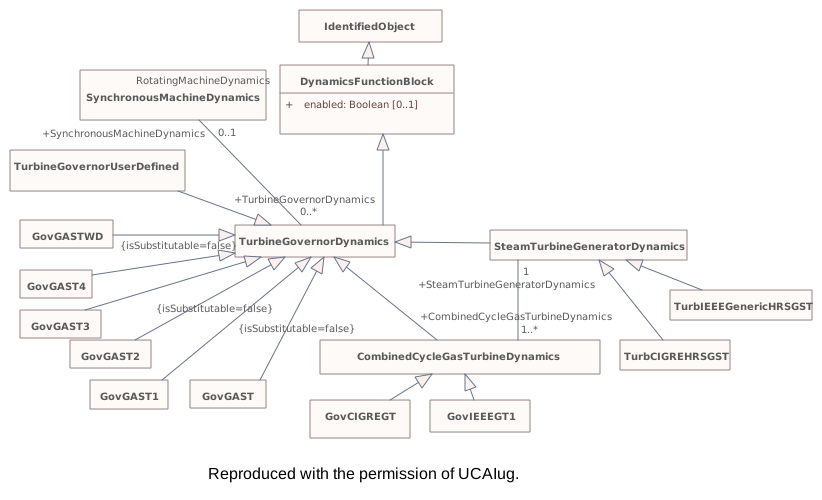
Destination
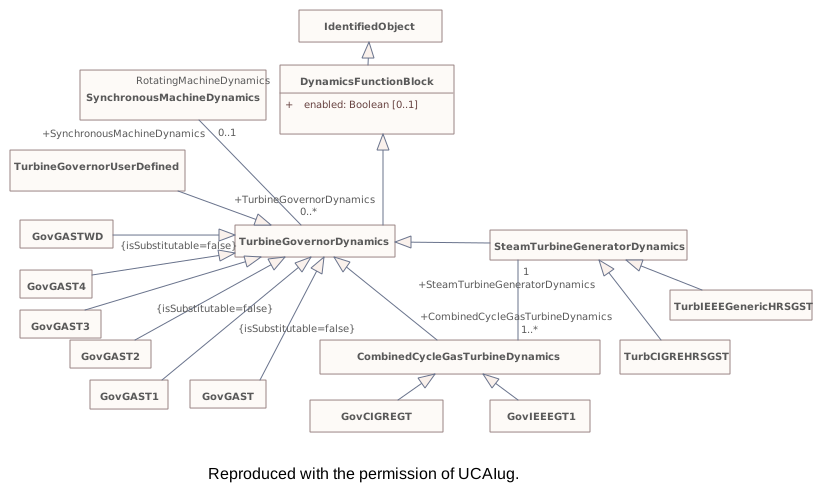
▶▦GovSteamFV4i
CHANGED{34F6E736-59B7-4047-879A-9CF1945755BC}
Diagram notes (destination, redlined)
This diagram describes the GovSteamFV4 turbine governor model<font color="#0f0f0f">.</font>
<font color="#0f0f0f">Parameter details:</font>
<ol>
<li>PU parameters are on base of MW capability of the turbine.</li>
<li>This model can be used for steam units in coordinated control, not belonging to a combined-cycle power plant.</li>
<li><i>omega</i> has units of per unit speed.</li>
<li>The characteristic using Kf1, Sf1 and alpha has the following details:</li>
</ol>
Ecf = 1 – Omega
If abs(Ecf) < Sf1 :
Cpfc = 0
else:
Cpfc = Kf1 * (abs(Ecf) – Sf1)
If Cpfc > Lps
Cpfc = Lps
If Cpfc < Lpi
Cpfc = Lpi
where Kf1 is the slope of the characteristic; Alpha is the angle of the slope used only for diagram explanation and the deadband is Sf1.Diagram metadata — changes
| Baseline | Destination | |
|---|---|---|
| ModifiedDate | 2022-03-18 21:49:59 | 2023-03-04 09:42:50 |
Diagram notes (destination, redlined)
This diagram describes the GovSteamFV4 turbine governor model<font color="#0f0f0f">.</font>
<font color="#0f0f0f">Parameter details:</font>
<ol>
<li>PU parameters are on base of MW capability of the turbine.</li>
<li>This model can be used for steam units in coordinated control, not belonging to a combined-cycle power plant.</li>
<li><i>omega</i> has units of per unit speed.</li>
<li>The characteristic using Kf1, Sf1 and alpha has the following details:</li>
</ol>
Ecf = 1 – Omega
If abs(Ecf) < Sf1 :
Cpfc = 0
else:
Cpfc = Kf1 * (abs(Ecf) – Sf1)
If Cpfc > Lps
Cpfc = Lps
If Cpfc < Lpi
Cpfc = Lpi
where Kf1 is the slope of the characteristic; Alpha is the angle of the slope used only for diagram explanation and the deadband is Sf1.▤Metadata
| Baseline | Destination | |
|---|---|---|
| ModifiedDate | 2022-03-18 21:49:59 | 2023-03-04 09:42:50 |
Diagram 'GovSteamFV4' has no other changes. The shows its notes and every changed property.
▶▦HydroTurbineGovernorDynamicsi
CHANGED{5DD835FF-3AB1-450d-9050-A786FC349923}
Diagram notes
This diagram shows dynamic standard model hydro turbine-governor classes and their inheritance from the TurbineGovernorDynamics class.Diagram metadata — changes
| Baseline | Destination | |
|---|---|---|
| no changes | ||
Diagram notes
This diagram shows dynamic standard model hydro turbine-governor classes and their inheritance from the TurbineGovernorDynamics class.▦Diagram
changed
Baseline
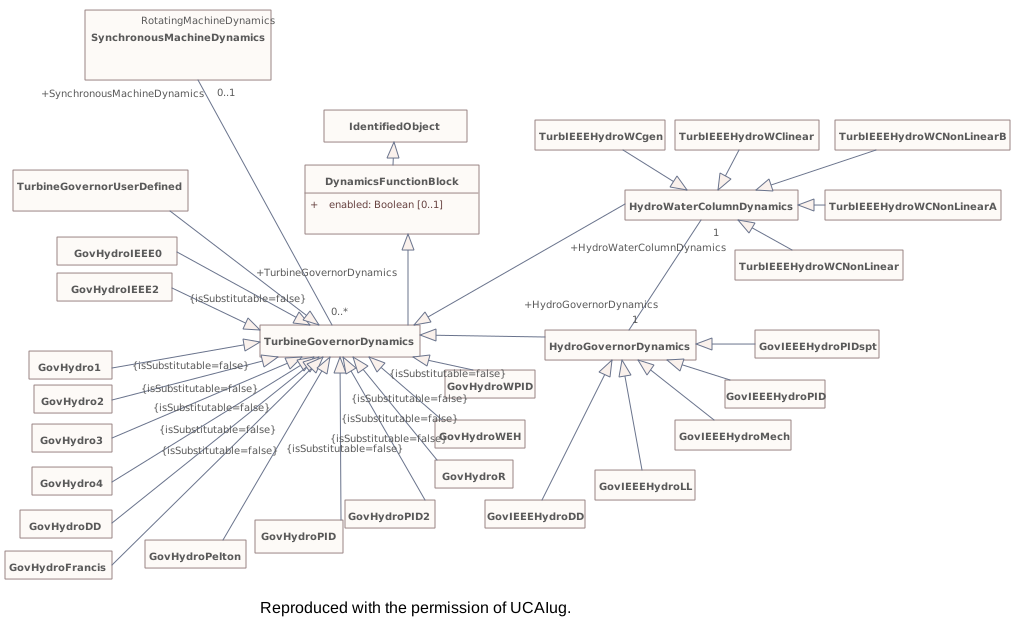
Destination
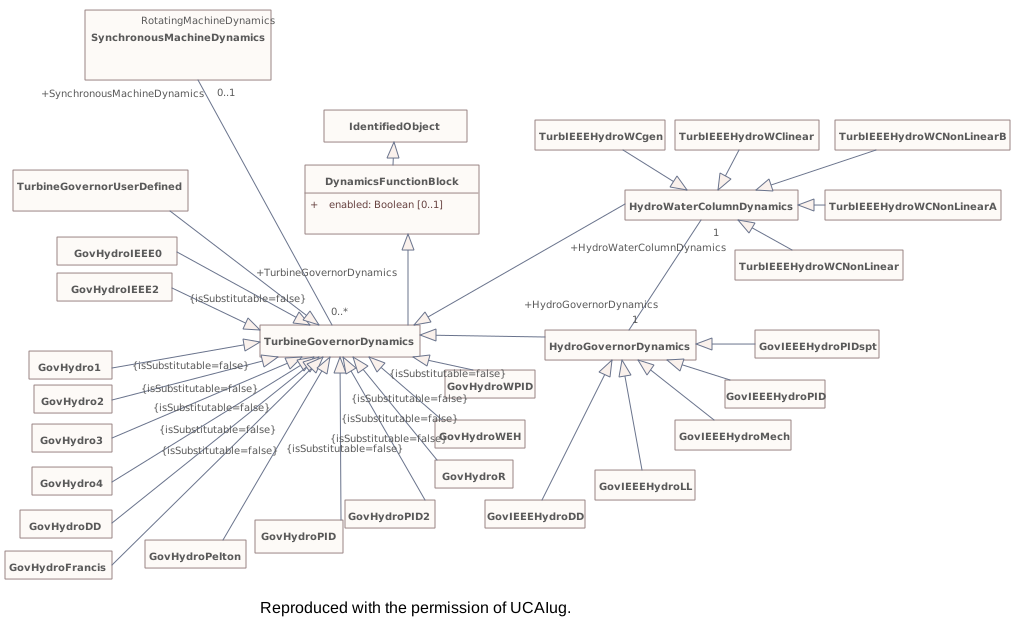
▶▦SteamTurbineGovernorDynamicsi
CHANGED{D646BBA5-04C5-4745-9D16-606392088DF9}
Diagram notes
This diagram shows dynamic standard model steam turbine-governor classes and their inheritance from the TurbineGovernorDynamics class.Diagram metadata — changes
| Baseline | Destination | |
|---|---|---|
| no changes | ||
Diagram notes
This diagram shows dynamic standard model steam turbine-governor classes and their inheritance from the TurbineGovernorDynamics class.▦Diagram
changed
Baseline
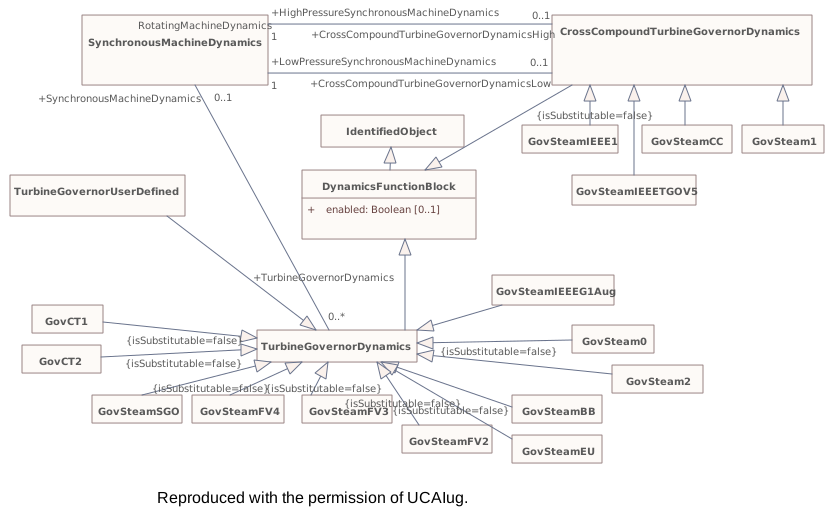
Destination
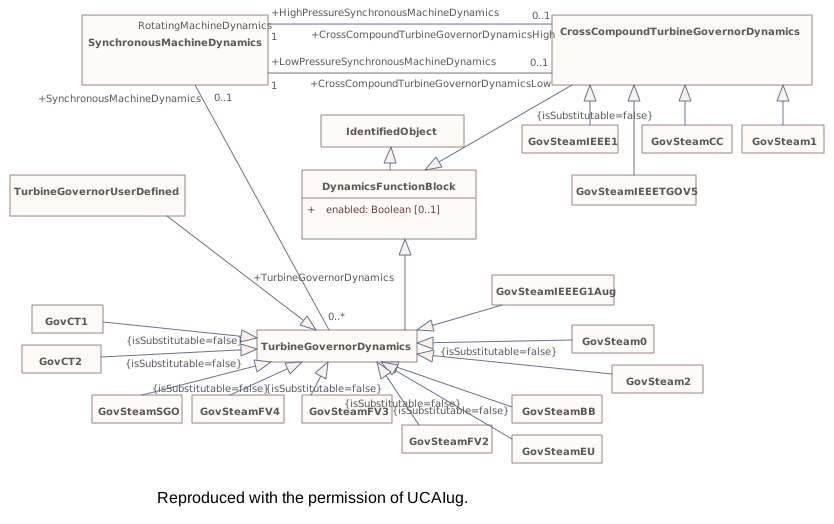
▶ExcitationSystemDynamicsi
{829F67E7-F698-4aa7-95C2-13C616AB6B78}
Package notes
The excitation system model provides the field voltage (<i>Efd</i>) for a synchronous machine model. It is linked to a specific generator (synchronous machine).
The representation of all limits used by the models (not including IEEE standard models) shall comply with the representation defined in Annex E of IEEE 421.5-2005, unless specified differently in the documentation of the model.
The parameters are different for each excitation system model; the same parameter name can have different meaning in different models.Package metadata — changes
| Baseline | Destination | |
|---|---|---|
| no changes | ||
Tagged values — changes
| Baseline | Destination | |
|---|---|---|
| no changes | ||
Package notes
The excitation system model provides the field voltage (<i>Efd</i>) for a synchronous machine model. It is linked to a specific generator (synchronous machine).
The representation of all limits used by the models (not including IEEE standard models) shall comply with the representation defined in Annex E of IEEE 421.5-2005, unless specified differently in the documentation of the model.
The parameters are different for each excitation system model; the same parameter name can have different meaning in different models.▶IEEE4215from2005i
{D22779BB-015E-4250-9959-87234042A65F}
Package notes
Excitation system models from IEEE 421.5-2005.Package metadata — changes
| Baseline | Destination | |
|---|---|---|
| no changes | ||
Tagged values — changes
| Baseline | Destination | |
|---|---|---|
| no changes | ||
Package notes
Excitation system models from IEEE 421.5-2005.Changed classes (2)
▶⚙ExcIEEEAC8Bi
CHANGED{5A5BF11A-2D01-4ab7-9F3E-6F9D0EBA1054}
Class notes (destination, redlined)
IEEE 421.5-2005 type AC8B model. This model represents a PID voltage regulator with either a brushless exciter or DC exciter. The AVR in this model consists of PID control, with separate constants for the proportional (<i>K</i><i><sub>PR</sub></i>), integral (<i>K</i><i><sub>IR</sub></i>), and derivative (<i>K</i><i><sub>DR</sub></i>) gains. The representation of the brushless exciter (<i>T</i><i><sub>E</sub></i>, <i>K</i><i><sub>E</sub></i>, <i>S</i><i><sub>E</sub></i>, <i>K</i><i><sub>C</sub></i>, <i>K</i><i><sub>D</sub></i>) is similar to the model type AC2A. The type AC8B model can be used to represent static voltage regulators applied to brushless excitation systems. Digitally based voltage regulators feeding DC rotating main exciters can be represented with the AC type AC8B model with the parameters <i>K</i><i><sub>C</sub></i> and <i>K</i><i><sub>D</sub></i> set to 0. For thyristor power stages fed from the generator terminals, the limits <i>V</i><i><sub>RMAX</sub></i> and <i>V</i><i><sub>RMIN</sub></i><i> </i>should be a function of terminal voltage: V<i><sub>T</sub></i> x <i>V</i><i><sub>RMAX</sub></i><sub> </sub>and <i>V</i><i><sub>T</sub></i> x <i>V</i><i><sub>RMIN</sub></i>. However, this model is not supporting this, hence the model AC8C from IEEE 421.5-2016, 7.17 (ExcIEEEAC8C) should be used.
Reference: IEEE 421.5-2005, 6.8.
According to IEEE 421.5-2016, 7.16 the AC8B excitation system model is being superseded by the model AC8C (ExcIEEEAC8C).Class metadata — changes
| Baseline | Destination | |
|---|---|---|
| no changes | ||
Tagged values — changes
| Baseline | Destination | |
|---|---|---|
| no changes | ||
Class notes (destination, redlined)
IEEE 421.5-2005 type AC8B model. This model represents a PID voltage regulator with either a brushless exciter or DC exciter. The AVR in this model consists of PID control, with separate constants for the proportional (<i>K</i><i><sub>PR</sub></i>), integral (<i>K</i><i><sub>IR</sub></i>), and derivative (<i>K</i><i><sub>DR</sub></i>) gains. The representation of the brushless exciter (<i>T</i><i><sub>E</sub></i>, <i>K</i><i><sub>E</sub></i>, <i>S</i><i><sub>E</sub></i>, <i>K</i><i><sub>C</sub></i>, <i>K</i><i><sub>D</sub></i>) is similar to the model type AC2A. The type AC8B model can be used to represent static voltage regulators applied to brushless excitation systems. Digitally based voltage regulators feeding DC rotating main exciters can be represented with the AC type AC8B model with the parameters <i>K</i><i><sub>C</sub></i> and <i>K</i><i><sub>D</sub></i> set to 0. For thyristor power stages fed from the generator terminals, the limits <i>V</i><i><sub>RMAX</sub></i> and <i>V</i><i><sub>RMIN</sub></i><i> </i>should be a function of terminal voltage: V<i><sub>T</sub></i> x <i>V</i><i><sub>RMAX</sub></i><sub> </sub>and <i>V</i><i><sub>T</sub></i> x <i>V</i><i><sub>RMIN</sub></i>. However, this model is not supporting this, hence the model AC8C from IEEE 421.5-2016, 7.17 (ExcIEEEAC8C) should be used.
Reference: IEEE 421.5-2005, 6.8.
According to IEEE 421.5-2016, 7.16 the AC8B excitation system model is being superseded by the model AC8C (ExcIEEEAC8C).Class 'ExcIEEEAC8B' has no other changes. The shows its notes and every changed property.
▶⚙ExcIEEEST6Bi
CHANGED{7A625070-2B4A-48c0-BB20-C7C7DD709BC5}
Class notes (destination, redlined)
IEEE 421.5-2005 type ST6B model. This model consists of a PI voltage regulator with an inner loop field voltage regulator and pre-control. The field voltage regulator implements a proportional control. The pre-control and the delay in the feedback circuit increase the dynamic response. This model is not supporting Vb signal in a correct way, hence the model ST6C from IEEE 421.5-2016, 8.13 (ExcIEEEST6C) should be used.
Parameter details:
<ol>
<li>The sign of the signal Voel is not correct in IEEE 421.5-2005. The sign in IEEE 421.5-2016 shall be used.</li>
</ol>
Reference: IEEE 421.5-2005, 7.6.
According to IEEE 421.5-2016, 8.12 the ST6B excitation system model is being superseded by the model ST6C (ExcIEEEST6C).Class metadata — changes
| Baseline | Destination | |
|---|---|---|
| no changes | ||
Tagged values — changes
| Baseline | Destination | |
|---|---|---|
| no changes | ||
Class notes (destination, redlined)
IEEE 421.5-2005 type ST6B model. This model consists of a PI voltage regulator with an inner loop field voltage regulator and pre-control. The field voltage regulator implements a proportional control. The pre-control and the delay in the feedback circuit increase the dynamic response. This model is not supporting Vb signal in a correct way, hence the model ST6C from IEEE 421.5-2016, 8.13 (ExcIEEEST6C) should be used.
Parameter details:
<ol>
<li>The sign of the signal Voel is not correct in IEEE 421.5-2005. The sign in IEEE 421.5-2016 shall be used.</li>
</ol>
Reference: IEEE 421.5-2005, 7.6.
According to IEEE 421.5-2016, 8.12 the ST6B excitation system model is being superseded by the model ST6C (ExcIEEEST6C).Class 'ExcIEEEST6B' has no other changes. The shows its notes and every changed property.
Package 'IEEE4215from2005' has no changes to the 1 diagrams it contains.
Package 'ExcitationSystemDynamics' has no changes to the 42 classes it contains.
Package 'ExcitationSystemDynamics' has no changes to the 39 diagrams it contains.
▶OverexcitationLimiterDynamicsi
{CB5C7172-23DD-4cc0-ACF3-557E0496AFCD}
Package notes
Overexcitation limiters (OELs) are also referred to as <i>maximum excitation limiters </i>and <i>field current limiters. </i>The possibility of voltage collapse in stressed power systems increases the importance of modelling these limiters in studies of system conditions that cause machines to operate at high levels of excitation for a sustained period, such as voltage collapse or system-islanding. Such events typically occur over a long time frame compared with transient or small-signal stability simulations.Package metadata — changes
| Baseline | Destination | |
|---|---|---|
| no changes | ||
Tagged values — changes
| Baseline | Destination | |
|---|---|---|
| no changes | ||
Package notes
Overexcitation limiters (OELs) are also referred to as <i>maximum excitation limiters </i>and <i>field current limiters. </i>The possibility of voltage collapse in stressed power systems increases the importance of modelling these limiters in studies of system conditions that cause machines to operate at high levels of excitation for a sustained period, such as voltage collapse or system-islanding. Such events typically occur over a long time frame compared with transient or small-signal stability simulations.Added classes (1)
▶⚙OverExcitationLimiterInputKind«enumeration»i
ADDED{A26EE93B-5F15-440e-A52C-902FB71DFB77}
Class notes
Defines the kinds of inputs for over excitation limiter.Class metadata — changes
| Baseline | Destination | |
|---|---|---|
| Abstract | false | |
| Author | chiva | |
| Complexity | 1 | |
| GenType | Java | |
| IsLeaf | false | |
| IsRoot | false | |
| IsSpec | false | |
| Name | OverExcitationLimiterInputKind | |
| ParentPackage | OverexcitationLimiterDynamics | |
| Phase | 1.0 | |
| Scope | public | |
| Status | Proposed | |
| Stereotype | enumeration | |
| Type | Class | |
| Version | 1.0 |
Tagged values — changes
| Baseline | Destination | |
|---|---|---|
| none | ||
Class notes
Defines the kinds of inputs for over excitation limiter.▤Metadata
| Baseline | Destination | |
|---|---|---|
| Abstract | false | |
| Author | chiva | |
| Complexity | 1 | |
| GenType | Java | |
| IsLeaf | false | |
| IsRoot | false | |
| IsSpec | false | |
| Name | OverExcitationLimiterInputKind | |
| ParentPackage | OverexcitationLimiterDynamics | |
| Phase | 1.0 | |
| Scope | public | |
| Status | Proposed | |
| Stereotype | enumeration | |
| Type | Class | |
| Version | 1.0 |
≡Attributes
| Attribute | Baseline | Destination | Notes (destination, redlined) | ||||||||||||||||||||||||||||||||||||||||||||||||
|---|---|---|---|---|---|---|---|---|---|---|---|---|---|---|---|---|---|---|---|---|---|---|---|---|---|---|---|---|---|---|---|---|---|---|---|---|---|---|---|---|---|---|---|---|---|---|---|---|---|---|---|
| exciterFieldCurrenti{A1A41C4C-99D3-41fa-9FBA-CE521FCD9C50}show details | did not exist | [1..1] | Exciter field current Vfe. | ||||||||||||||||||||||||||||||||||||||||||||||||
Attribute notes Exciter field current Vfe.Attribute metadata — changes
Tagged values — changes
| |||||||||||||||||||||||||||||||||||||||||||||||||||
| generatorFieldCurrenti{E25A52BF-94C3-40f2-B7B2-1C5298013C85}show details | did not exist | [1..1] | Generator field current Ifd. | ||||||||||||||||||||||||||||||||||||||||||||||||
Attribute notes Generator field current Ifd.Attribute metadata — changes
Tagged values — changes
| |||||||||||||||||||||||||||||||||||||||||||||||||||
| generatorFieldVoltagei{ED23D05F-3999-4255-AFF8-6FCD3E55673A}show details | did not exist | [1..1] | Generator field voltage Efd. | ||||||||||||||||||||||||||||||||||||||||||||||||
Attribute notes Generator field voltage Efd.Attribute metadata — changes
Tagged values — changes
| |||||||||||||||||||||||||||||||||||||||||||||||||||
Changed classes (3)
▶⚙OverexcLimIEEEOEL2Ci
CHANGED{A375B175-ED01-483b-81FE-9C356923B9BD}
Class notes
IEEE 421.5-2016 OEL2C overexcitation limiter model. This model is an extension of the OEL model proposed by the IEEE Task Force on Excitation Limiters. This model allows the representation of different OEL actions, such as instantaneous and inverse-time responses. Also, the timed response could follow fixed ramp rates (definite time response) or use ramp rates proportional to the level of overexcitation. Furthermore, this model can represent summation point or takeover OEL implementations.
Reference: IEEE 421.5-2016, 10.5.Class metadata — changes
| Baseline | Destination | |
|---|---|---|
| no changes | ||
Tagged values — changes
| Baseline | Destination | |
|---|---|---|
| no changes | ||
Class notes
IEEE 421.5-2016 OEL2C overexcitation limiter model. This model is an extension of the OEL model proposed by the IEEE Task Force on Excitation Limiters. This model allows the representation of different OEL actions, such as instantaneous and inverse-time responses. Also, the timed response could follow fixed ramp rates (definite time response) or use ramp rates proportional to the level of overexcitation. Furthermore, this model can represent summation point or takeover OEL implementations.
Reference: IEEE 421.5-2016, 10.5.≡Attributes
| Attribute | Baseline | Destination | Notes (destination, redlined) | |||||||||||||||||||||||||||||||||||||||||||||
|---|---|---|---|---|---|---|---|---|---|---|---|---|---|---|---|---|---|---|---|---|---|---|---|---|---|---|---|---|---|---|---|---|---|---|---|---|---|---|---|---|---|---|---|---|---|---|---|---|
| inputSignalKindi{658CEA24-BE61-4303-8187-7B5E0E00B2F4}show details | did not exist | OverExcitationLimiterInputKind [0..1] | Type of input signal OEL input. | |||||||||||||||||||||||||||||||||||||||||||||
Attribute notes Type of input signal OEL input.Attribute metadata — changes
Tagged values — changes
| ||||||||||||||||||||||||||||||||||||||||||||||||
▶⚙OverexcLimIEEEOEL3Ci
CHANGED{0F50F696-195F-487e-982C-BF092B7B4A35}
Class notes
IEEE 421.5-2016 OEL3C overexcitation limiter model. This model reduces voltage reference and thus terminal voltage in order to reduce field current according to an adjustable time characteristic. The reduction in voltage reference occurs whenever the actual excitation (field current) is greater than a pickup (reference) value. The pickup value is a constant value, which should be sufficient for representation of an OEL system in system studies. It should be recognized that the pickup value could be a function of the cold gas temperature of the generator, but that effect is not represented in this model.
Reference: IEEE 421.5-2016, 10.6.Class metadata — changes
| Baseline | Destination | |
|---|---|---|
| no changes | ||
Tagged values — changes
| Baseline | Destination | |
|---|---|---|
| no changes | ||
Class notes
IEEE 421.5-2016 OEL3C overexcitation limiter model. This model reduces voltage reference and thus terminal voltage in order to reduce field current according to an adjustable time characteristic. The reduction in voltage reference occurs whenever the actual excitation (field current) is greater than a pickup (reference) value. The pickup value is a constant value, which should be sufficient for representation of an OEL system in system studies. It should be recognized that the pickup value could be a function of the cold gas temperature of the generator, but that effect is not represented in this model.
Reference: IEEE 421.5-2016, 10.6.≡Attributes
| Attribute | Baseline | Destination | Notes (destination, redlined) | |||||||||||||||||||||||||||||||||||||||||||||
|---|---|---|---|---|---|---|---|---|---|---|---|---|---|---|---|---|---|---|---|---|---|---|---|---|---|---|---|---|---|---|---|---|---|---|---|---|---|---|---|---|---|---|---|---|---|---|---|---|
| inputSignalKindi{827A07CF-F42B-426d-9FF0-BCC196AA7939}show details | did not exist | OverExcitationLimiterInputKind [0..1] | Type of input signal OEL input. | |||||||||||||||||||||||||||||||||||||||||||||
Attribute notes Type of input signal OEL input.Attribute metadata — changes
Tagged values — changes
| ||||||||||||||||||||||||||||||||||||||||||||||||
▶⚙OverexcLimIEEEOEL5Ci
CHANGED{7084B1E5-CDAB-4914-AAF5-1A0DD4966C9A}
Class notes
IEEE 421.5-2016 OEL5C overexcitation limiter model. This model represents a take-over type function which replaces the normal input to the firing circuits. The output of the model is the result of either the generator field current regulator or the exciter field current regulator.
Reference: IEEE 421.5-2016, 10.8.Class metadata — changes
| Baseline | Destination | |
|---|---|---|
| no changes | ||
Tagged values — changes
| Baseline | Destination | |
|---|---|---|
| no changes | ||
Class notes
IEEE 421.5-2016 OEL5C overexcitation limiter model. This model represents a take-over type function which replaces the normal input to the firing circuits. The output of the model is the result of either the generator field current regulator or the exciter field current regulator.
Reference: IEEE 421.5-2016, 10.8.≡Attributes
| Attribute | Baseline | Destination | Notes (destination, redlined) | |||||||||||||||||||||||||||||||||||||||||||||
|---|---|---|---|---|---|---|---|---|---|---|---|---|---|---|---|---|---|---|---|---|---|---|---|---|---|---|---|---|---|---|---|---|---|---|---|---|---|---|---|---|---|---|---|---|---|---|---|---|
| inputSignalKindi{3A71AF5C-9318-4030-9CFB-3054E461B1C3}show details | did not exist | OverExcitationLimiterInputKind [0..1] | Type of input signal OEL input. | |||||||||||||||||||||||||||||||||||||||||||||
Attribute notes Type of input signal OEL input.Attribute metadata — changes
Tagged values — changes
| ||||||||||||||||||||||||||||||||||||||||||||||||
Changed diagrams (1)
▶▦OverexcitationLimiterDynamicsi
CHANGED{FC47C181-4791-474a-AB30-CF1D0E20F49F}
Diagram notes
This diagram shows dynamic standard model overexcitation limiter classes and their inheritance from the OverexcitationLimiterDynamics class.Diagram metadata — changes
| Baseline | Destination | |
|---|---|---|
| ModifiedDate | 2022-03-18 22:52:55 | 2023-03-04 08:34:23 |
Diagram notes
This diagram shows dynamic standard model overexcitation limiter classes and their inheritance from the OverexcitationLimiterDynamics class.▤Metadata
| Baseline | Destination | |
|---|---|---|
| ModifiedDate | 2022-03-18 22:52:55 | 2023-03-04 08:34:23 |
▦Diagram
changedmoved or resized
Baseline
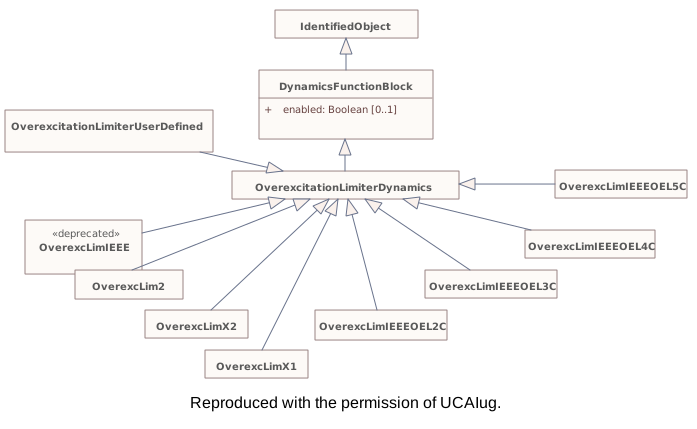
Destination
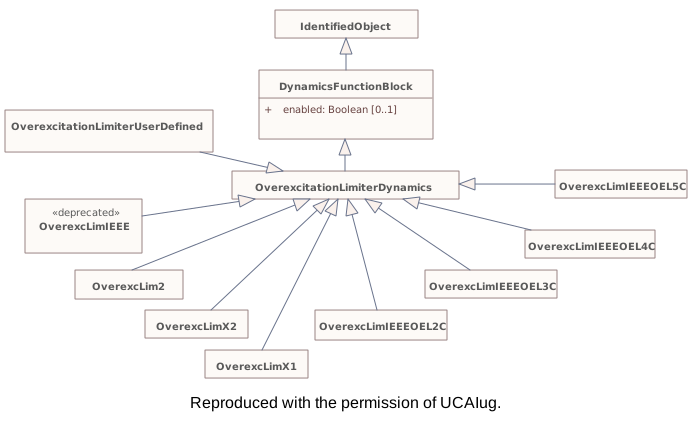
Package 'StandardModels' has no changes to the 2 classes it contains.
▶DetailedModelDescriptioni
{253FE232-028A-4a6e-AA8F-420138B1EF38}
Package notes
This clause packages classes needed to describe a model for dynamics simulations. This approach enables parties to exchange user defined model description expressed as mathematical expressions. It can also be used to describe standard models. Different profiles that use this information model shall make a choice of language used to describe the equations. The model enables creation of two separate profiles:
1) a profile to describe the detailed model configuration, and
2) a profile to enable an exchange of parameters of the model described using profile defined in 1).Package metadata — changes
| Baseline | Destination | |
|---|---|---|
| no changes | ||
Tagged values — changes
| Baseline | Destination | |
|---|---|---|
| no changes | ||
Package notes
This clause packages classes needed to describe a model for dynamics simulations. This approach enables parties to exchange user defined model description expressed as mathematical expressions. It can also be used to describe standard models. Different profiles that use this information model shall make a choice of language used to describe the equations. The model enables creation of two separate profiles:
1) a profile to describe the detailed model configuration, and
2) a profile to enable an exchange of parameters of the model described using profile defined in 1).Package 'DetailedModelDescription' has no changes to the 19 classes it contains.
Changed diagrams (1)
▶▦DetailedModelDescriptioni
CHANGED{25C584F8-6BE5-4947-9DEB-059BA8F93CBC}
Diagram notes
The diagram presents the classes used in the detailed model description approach of exchange dynamics models.Diagram metadata — changes
| Baseline | Destination | |
|---|---|---|
| no changes | ||
Diagram notes
The diagram presents the classes used in the detailed model description approach of exchange dynamics models.▦Diagram
changed
Baseline
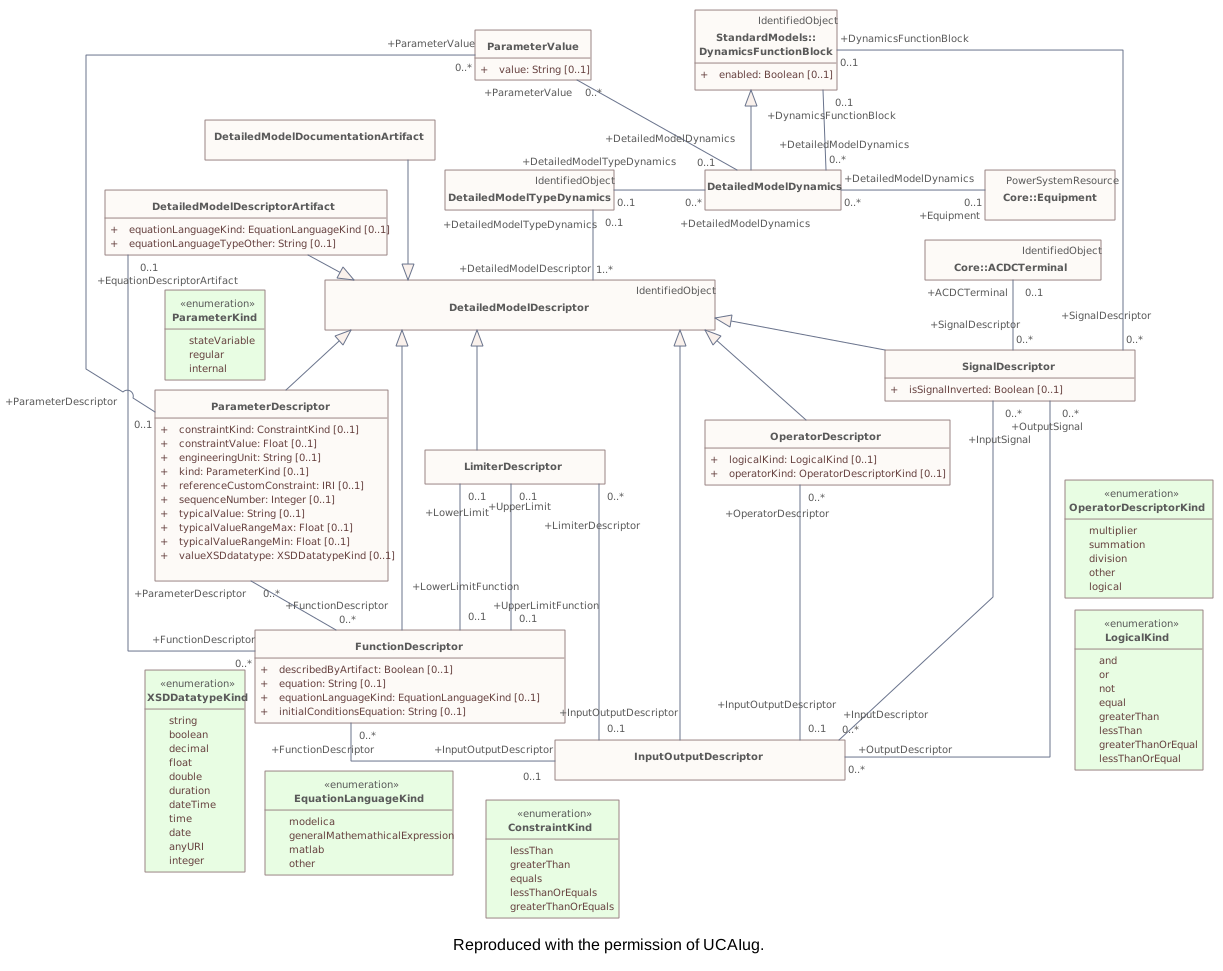
Destination
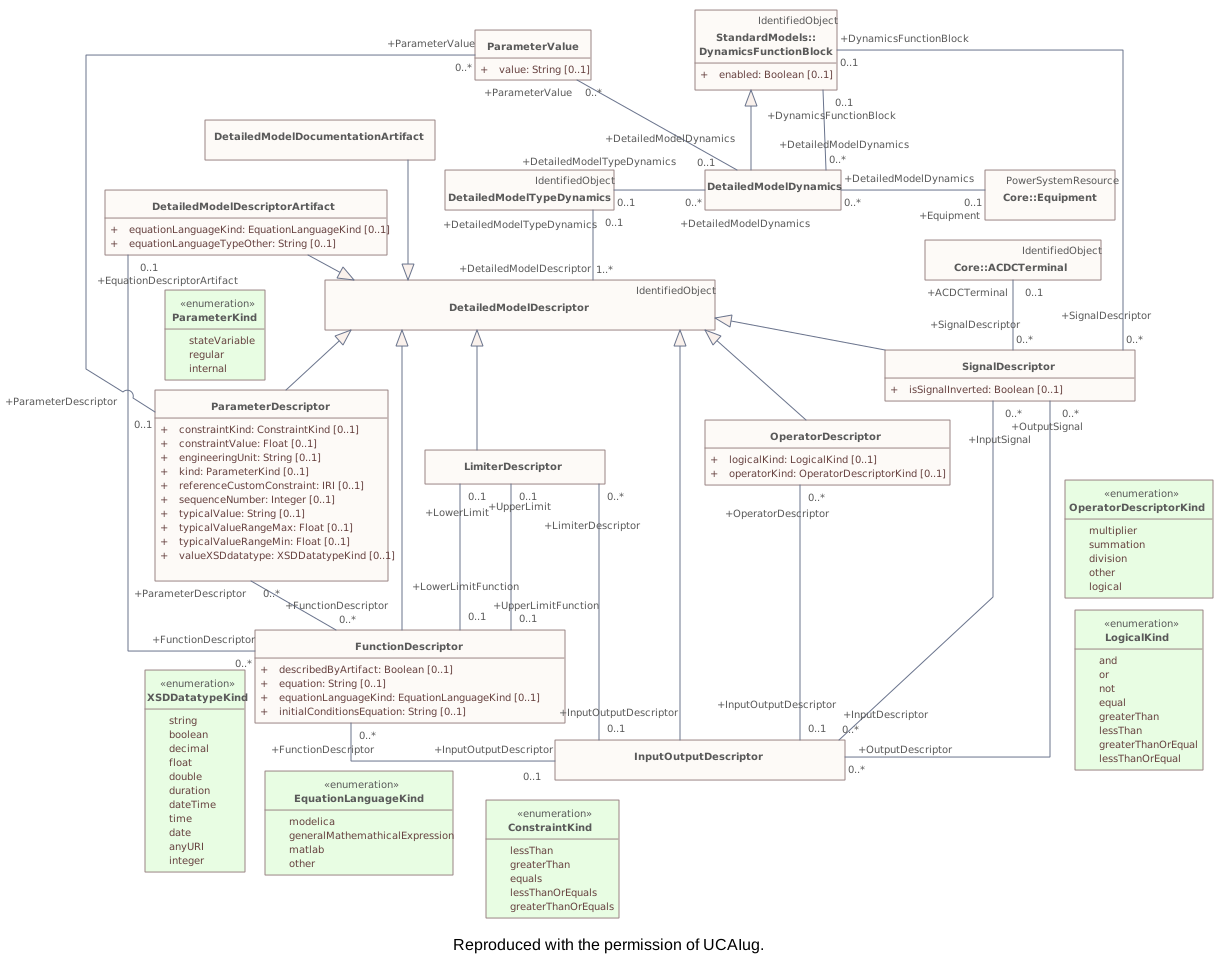
▶SimulationResulti
{F46BFE09-1F7D-4908-90ED-4A9799CF92B0}
Package notes
This clause contains classes needed to describe dynamics simulation settings and results.Package metadata — changes
| Baseline | Destination | |
|---|---|---|
| no changes | ||
Tagged values — changes
| Baseline | Destination | |
|---|---|---|
| no changes | ||
Package notes
This clause contains classes needed to describe dynamics simulation settings and results.Package 'SimulationResult' has no changes to the 14 classes it contains.
Changed diagrams (1)
▶▦SimulationResulti
CHANGED{3B18EC92-2D46-4747-85A5-7D1957304C6D}
Diagram notes
The diagram presents the classes used in the part of the model used to exchange dynamics simulation results.Diagram metadata — changes
| Baseline | Destination | |
|---|---|---|
| no changes | ||
Diagram notes
The diagram presents the classes used in the part of the model used to exchange dynamics simulation results.▦Diagram
changed
Baseline
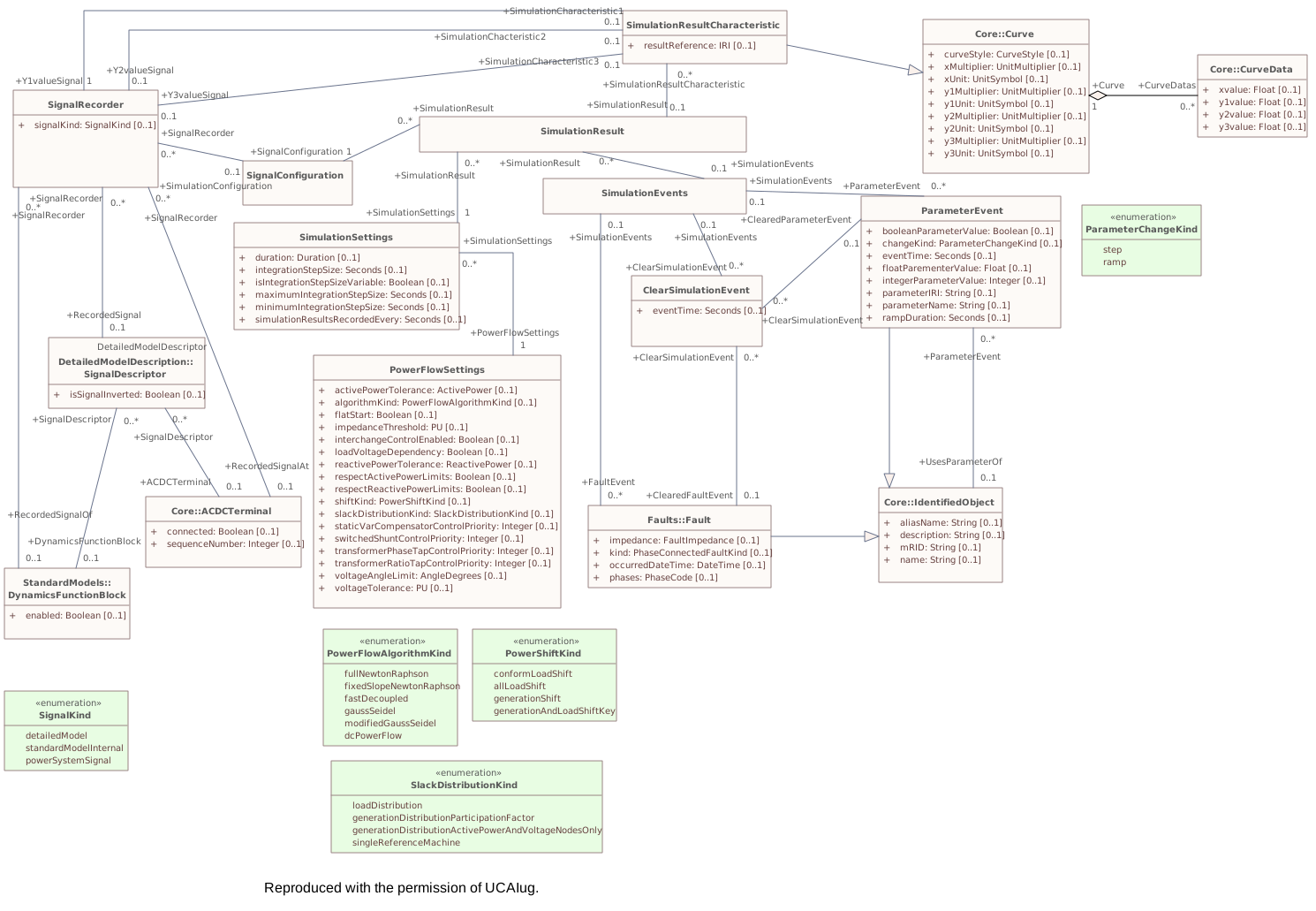
Destination
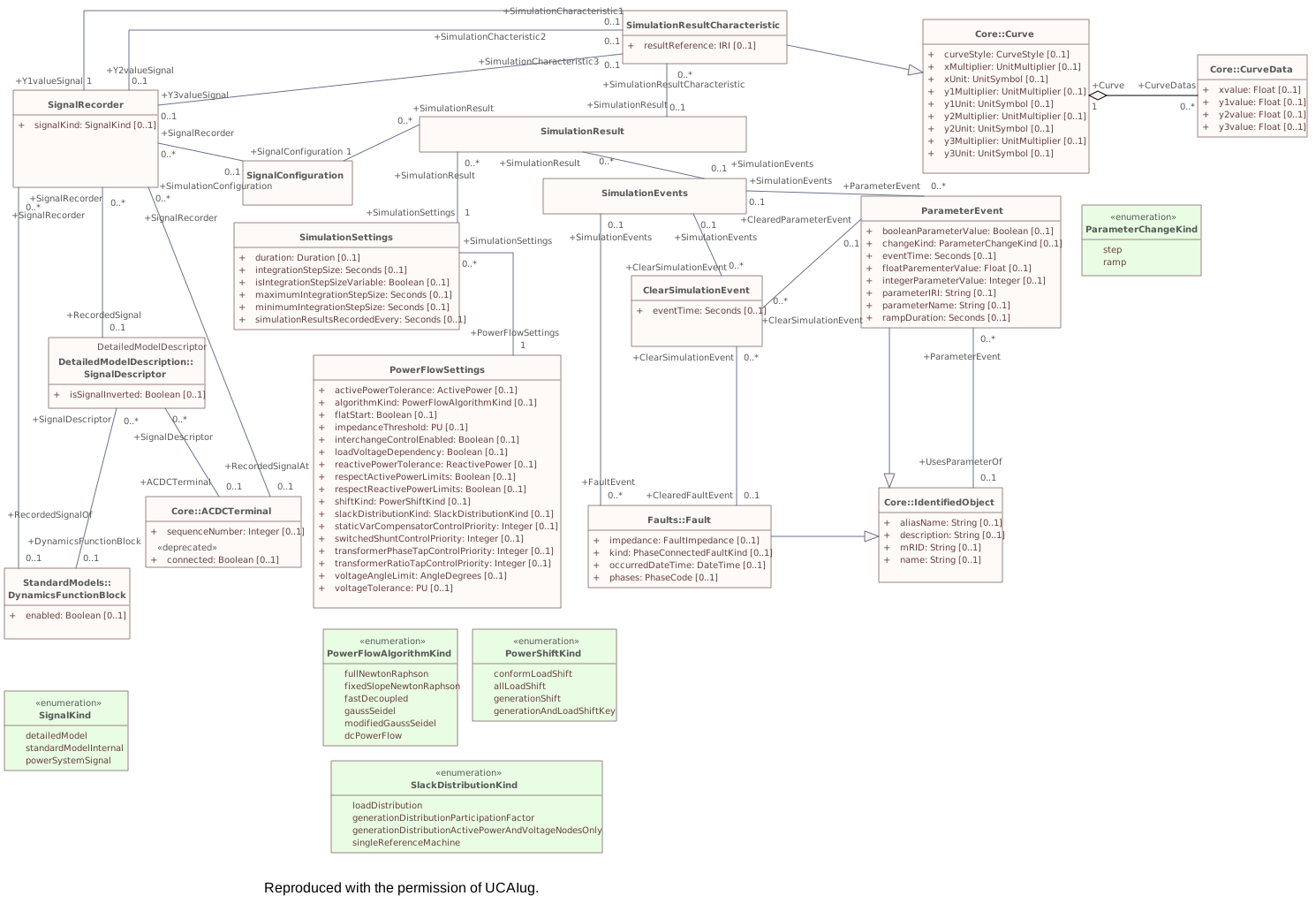
Changed classes (1)
▶⚙GridCIMVersioni
CHANGED{990AB50C-5CF8-46d2-B5FF-887BBBD3346F}
Class notes
This is the release version number assigned to Grid part of the CIM model. It is a point-in-time snapshot of the state of the CIM UML model that reflects a formal release of the CIM. This release version is distinct from the unique version (e.g. http://ucaiug.org/CIM/Base/1.0) associated with each package in the UML.Class metadata — changes
| Baseline | Destination | |
|---|---|---|
| no changes | ||
Tagged values — changes
| Baseline | Destination | |
|---|---|---|
| no changes | ||
Class notes
This is the release version number assigned to Grid part of the CIM model. It is a point-in-time snapshot of the state of the CIM UML model that reflects a formal release of the CIM. This release version is distinct from the unique version (e.g. http://ucaiug.org/CIM/Base/1.0) associated with each package in the UML.≡Attributes
| Attribute | Baseline | Destination | Notes (destination, redlined) | ||||||||||||
|---|---|---|---|---|---|---|---|---|---|---|---|---|---|---|---|
| dateimetadata changed - hovermetadata changed{8DADB97F-283D-40c7-A25A-D75E4C0D8507}show details | Date [0..1] | Date [0..1] | Form is YYYY-MM-DD for example for January 5, 2009 it is 2009-01-05. | ||||||||||||
Attribute notes Form is YYYY-MM-DD for example for January 5, 2009 it is 2009-01-05.Attribute metadata — changes
Tagged values — changes
| |||||||||||||||
| versionimetadata changed - hovermetadata changed{B4E0B1B6-8794-406a-A4C6-CBB395E37A52}show details | String [0..1] | String [0..1] | Form is XXvYY where XX is the major CIM release version and the YY is the minor version. For example 18v03. | ||||||||||||
Attribute notes Form is XXvYY where XX is the major CIM release version and the YY is the minor version. For example 18v03.Attribute metadata — changes
Tagged values — changes
| |||||||||||||||
Package 'Grid' has no changes to the 1 diagrams it contains.